Category Archives: Writing
Songs that make you go sniff
Did anyone hear Christy Moore on the John Murray show on RTÉ Radio One this morning? Christy played a selection from his back catalogue as requested by listeners. All the great songs were in there, including a favourite of mine, Lisdoonvarna. (“Amhráns, bodhráns and amadáns” is an all-time great lyrical gem.)

Christy Moore at the Liverpool Philharmonic, October 2008 (image: Wikimedia Commons)
This led met to think about the subject of personal musical tear-jerkers. It’s different for everyone; songs that have some people reaching for the tissue box can leave others indifferent. For me, one song in the tissue-box category is Christy Moore’s The Voyage. I had to turn off the radio this morning when the presenter announced it as the next song, because I didn’t want to start my writing day in floods of tears.
I realise that the words to The Voyage are not great poetry. The song is full of clichés. It over-extends the “boat / voyage / sea” metaphor beyond all reason. The feebleness of “together we’re in this relationship” with the emphasis on “ship” is hard to overlook. But none of this seems to matter. It is those very clichés and so-thinly-stretched-it’s-transparent imagery that hit a weak spot in my heart.
The lump in my throat begins at “determined not to fail” and progresses to distinctly glassy eyes at “working together we learned how to cope”. Full-blown, undeniable tears set in at “Now gathered round us, we have our own crew”.
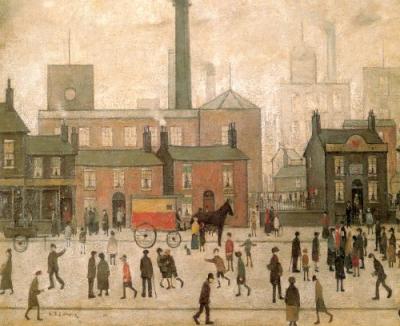
L.S. Lowry’s Coming Home from the Mill (1928). The 1978 tear-jerking hit song Matchstalk Men and Matchstalk Cats and Dogs was a tribute to Lowry.
For me, other songs in the same category include Roger Whittaker’s Durham Town and Brian and Michael’s Matchstalk Men and Matchstalk Cats and Dogs.
I’d love to hear how the rest of you feel. Maybe my top tearjerker The Voyage leaves you cold? What songs hit you in the Achilles heel of the heart?

Tapping into creativity for writers (you will need: Lego)
Who would have thought that tidying up some Lego would help with structuring a story?

I constantly have to keep in mind that writing time is for writing only and not other tasks, no matter how strong the temptation. Mostly, I am fairly successful at walking airily past household messes and sitting down at my desk to write.
One concession I sometimes allow myself is to do a quick tidy of the room I work in – after all, it is part writing den, part children’s play room. (The two parts are separated by room dividers from Woody’s – highly recommended if you share a writing space.)
So this morning I was in the play room / writing room, on my hands and knees (what a way to start the writing day), picking up Lego and mulling over the short story that I had started yesterday. I had most of the components of the story in my head: main character, secondary character, a strong visual image, and setting.
Some elements in the story are a little out of the ordinary, and I was stuck for “something” that would tie together all the pieces in a plausible way. I was beginning to get quite grumpy about being stuck and was wondering if I should just park the whole story.
As I tidied, an idea struck me and I began playing with a few of the pieces of Lego.
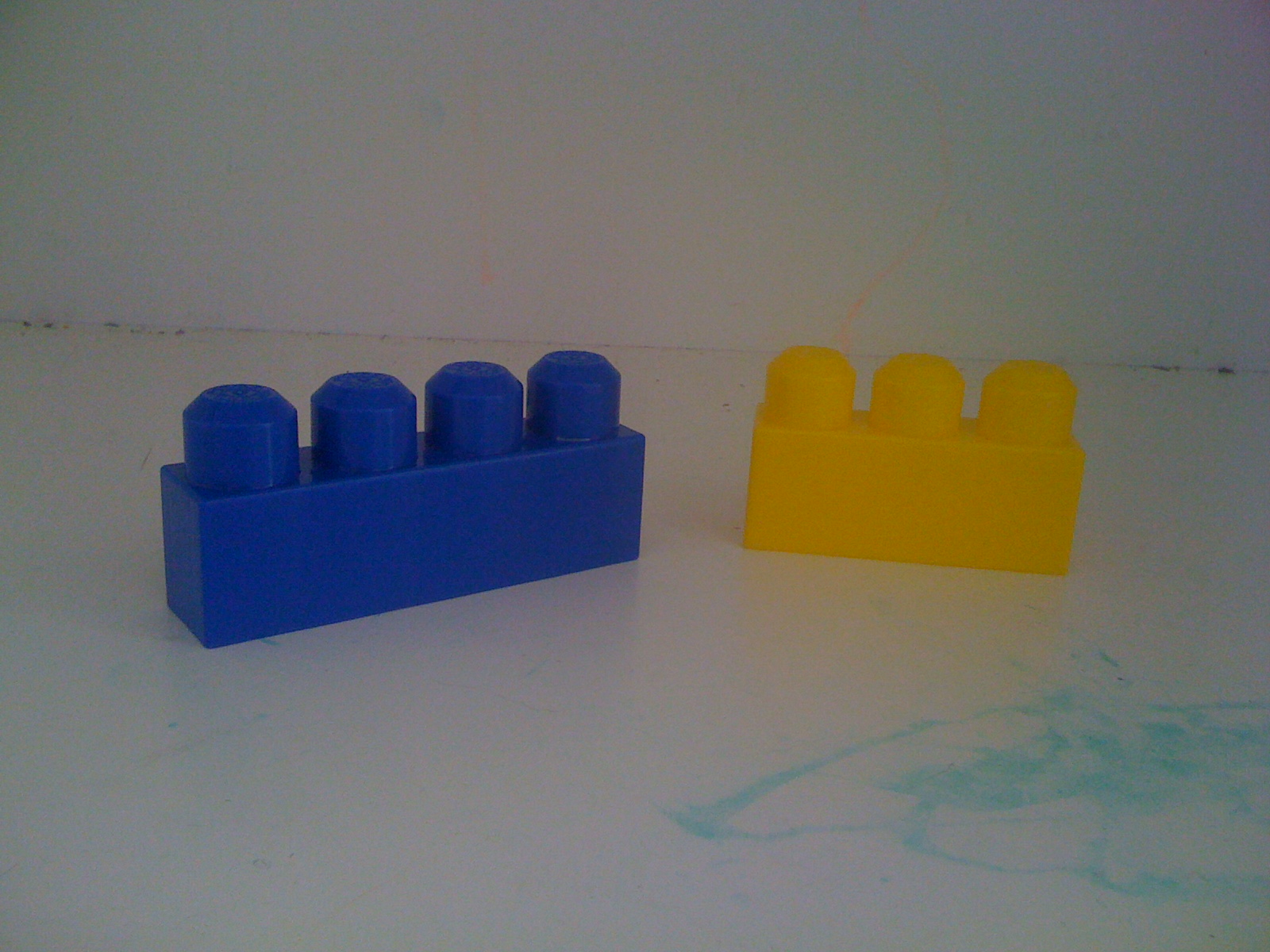
I selected a single yellow piece and put it on the kids’ play table. This was my main character – the component around which everything else in the story is built.

Then I took a bigger, blue piece. This is the story’s central visual image. It is strong in both size and appearance, like the image I have in mind. I placed this piece beside the yellow one, but not attached to it, just as the components of my story were disjointed at that point.
Next, I added a purple piece to the ensemble. This was the secondary character. I was really getting into the Lego-as-symbol thing at this stage, so I stuck this piece on top of the original yellow piece, but only partially, to show that the secondary character is only loosely connected to the main character at this point.
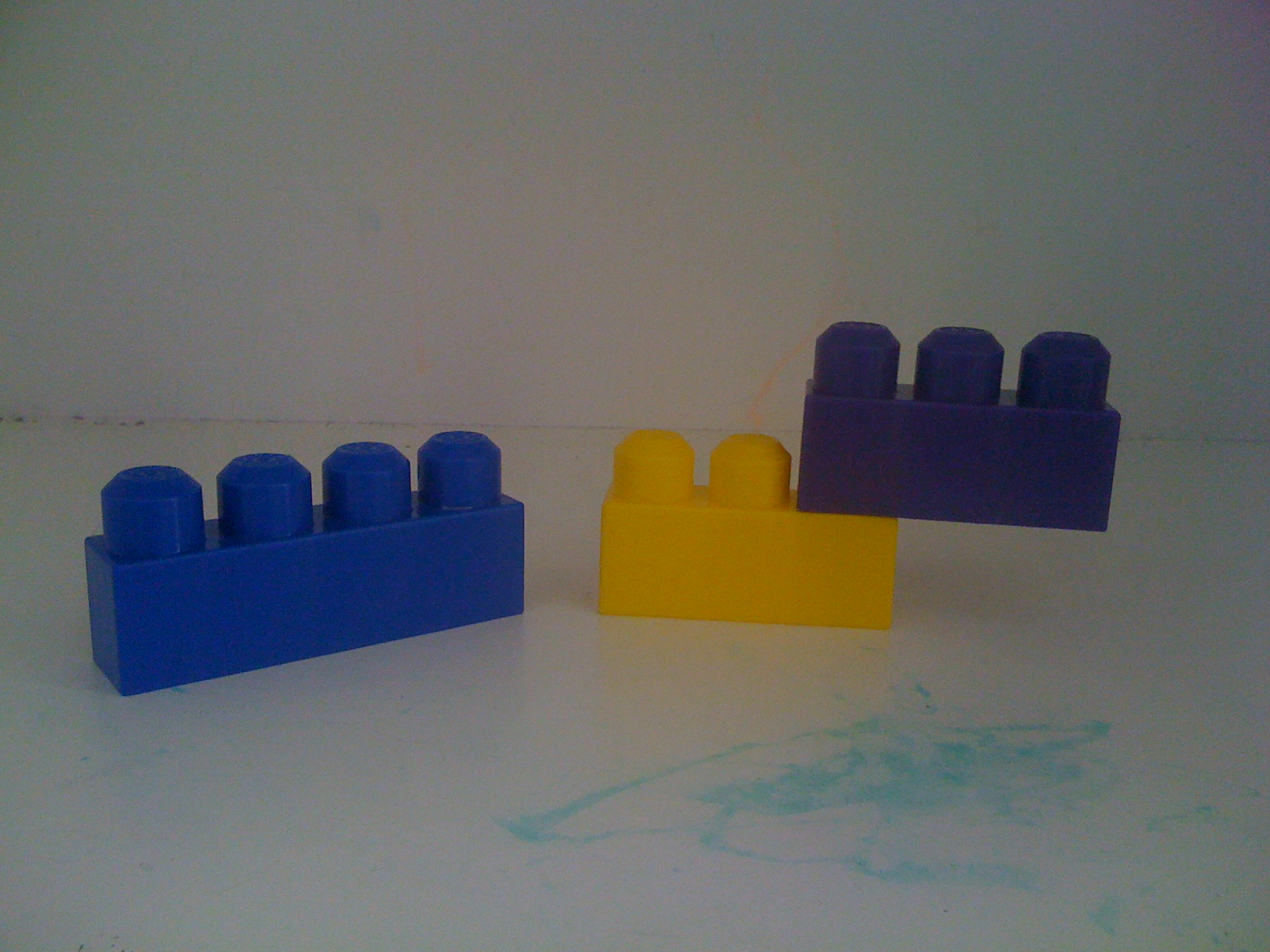
By now my Lego creation was looking like a bit of a mess, just like the story. (If I were someone like Tracey Emin, at this point I would probably throw something sticky at it before placing it in an exhibition and charging people money to look at it.) Something was definitely missing.
Then it hit me. My story needed another narrative layer to tie it all together. In other words, another character who would narrate the story as told to him or her. I remembered Wuthering Heights and how Charlotte Brontë famously used multiple narrators to make the book’s wildly romantic, sometimes fantastical characters and events plausible and believable to the reader.
I chose two long red Lego piece as my supporting, super-narrative layer and attached the existing structure to the top of it. The red pieces now supported everything else and connected it all together.

I have now started translating my Lego “creation” into words – that is, creating my additional narrative layer. This does raise questions about having too many characters, which can weigh down a short story. However, I am inspired (again) by Raymond Carver’s story “Fat”. This story’s main character tells her story to a friend over coffee, which is a variation of the technique; the reader hears the story as told to a third party.
The creativity that I was able to tap into by playing with the Lego led me to this solution. Techniques for tapping into creativity are something I have toyed with in the past but never devoted much attention to. I may re-visit them now.
Mind and mindfulness

This is called a “Mind Eraser”. I could do with one of these.
“Mind” is such a multi-purpose word, isn’t it? As a verb, it can mean to object to, to look after, and in a more archaic sense, to remember. As a noun, it encompasses all those nebulous concepts that we associate with our non-physical selves: the spirit, the personality, the intellect, among many others.
Today, my mind is all over the place. Since it is a work day, this poses a serious challenge. If my mind were connected to a printer, this is an extract from what it might be printing right now:
gottobookthatportraitsessionformysonmustphonetheeventspeakerfortomorrownightohgodidon’ttknowyet what’llimakefordinnermustsendthanktocardtofriendforlovelypartygottoremindhusbandtocomehomeearly onwednesdaybetterwritecheuqeforcommitteetreasurerohgodihaven’tmademuchprogressonmynewshortstory sincelastweekandihaven’tevenstartedontoday’sblogpost.
My mission for today – and I have no choice but to accept it, since I’m a writer – is to extract something meaningful from the whirl of nonsense in my mind. Right now, I feel like dangling by a rope from a precipitous cliff-face might be the easier task.

“Mindfulness: Finding peace in a frantic world” by Mark Williams and Danny Penman
One thing that really helps with calming a chaotic mind is Mindfulness. Those of you who have read Mindfulness: Finding peace in a frantic world by Mark Williams and Danny Penman will know what I mean. Those of you who haven’t, I strongly recommend it. The CD of guided mediations that comes with the book is worth it alone.
I find the first CD track, an eight-minute “body and breath” meditation, great for clearing the mind. The mind printer certainly outputs less of the scary, stream-of-consciousness stuff afterwards.
If anyone else in the writing field or other areas of the arts uses mindfulness techniques, either in conjunction with the book or otherwise, I’d love to hear about it. Just leave a comment below.
Being prepared…

Explaining your beliefs to other people… may my students be as rapt as these!
There’s nothing that makes you analyse your beliefs more than having to explain them to other people.
I’m coming up against this hard fact a lot at the moment, as I’m preparing to co-facilitate a half-day workshop. It’s called “Selling yourself without selling out”. (It’s for artists of all kinds, and aims to take the cringe factor out of self-promotion.) My co-facilitator is novelist, writer and creative writing tutor Derbhile Dromey.
For one thing, just because it’s obvious to me why using social media for self-promotion is a good idea for artists, workshop attendees may not necessarily agree whole-heartedly. So I am having to peel back the layers of my assumptions on that score, and come up with a way to elucidate my reasoning.
For another, like any skill as you practise it more, using social media for self-promotion as an artist becomes second nature. Consequently, if I am asked “Should I create a separate Facebook page for my artistic work, or can I just use my personal account?”, I really have to scratch my head to ensure that I give a clear answer. I know what I would do, but telling someone else what they should do, and why, is a different matter.
It’s all part of the preparation work, which, like anything worthwhile, is a time-consuming task.
On the plus side, I’m hugely excited about working with Derbhile and having the opportunity to support some fellow artists with their self-promotion work in the world of social media.

How long does overnight success take?
There is an inspiring new post by Rosie Lugosi on the Myslexia blog called “Hare / Tortoise”. In it, Rosie describes how her novel-writing career is finally taking off after twelve years of slog. The post has got me thinking about the cultural phenomenon of “overnight success”.
I have often mused about this with a friend who is also interested in the topic. We in the English-speaking world are obsessed with the idea of overnight success. It is the concept upon which talent shows like The X Factor are based: Someone is plucked from obscurity and thrust into the limelight on the strength of their amazing talent, which was just waiting to be discovered.

Mary Byrne on The X Factor
Mary Byrne and Susan Boyle are perfect examples. In the PR narrative that was presented along with them as they came to media prominence, both women (both undeniably very talented) had languished in obscurity for decades, their gift known only to their nearest and dearest, until Simon Cowell and co. swooped in to rescue them.
However, look a little more closely, and it emerges that both Ms. Byrne and Ms. Boyle had been singing for many years, and with some success, long before they went on The X Factor and Britain’s Got Talent, respectively.

Susan Boyle, runner-up in Britain’s Got Talent
Mary Byrne had been a singer in her brother’s band and had actually won a singing content on Irish TV in 2008. Susan Boyle began singing in school productions at age 12, and she and her mother often talked about her possibly becoming famous. She sang for years in pubs and local competitions before The X Factor. In both cases, they had worked and grafted away for years. There was nothing overnight about it.
As an artist, I resent the overnight success concept. Anyone who has ever achieved anything worthwhile, ever, no matter in what field, knows that it takes graft, graft, and then more graft. Staying up til all hours, getting up at all hours, working when you could be out socialising, working when you could be spending time with your family… and you keep doing all these things for months, years and quite possibly, your whole life. That is what lies behind most creative success.
There are several examples in fields other than showbiz: Search engine behemoth Google and the ridiculously popular game Angry Birds both appeared to gain incredible popularity in no time, whereas in actual fact, both took several years’ steady, unremarked-on work on the part of their creators.
Overnight success is a myth, in all senses of the word.
Despite this, as a human being, I love stuffing my rational brain into a drawer and gorging myself on reality TV sob stories.
So why are we so in love with the idea of being suddenly “discovered” and catapulted to instant success?

Cinderella, before Disney got her
It has to be something to do with the Cinderella meme that is still so strong in Anglo-Saxon culture. We all love a good rags-to-riches tale, and the Disneyfied Cinderella, the version now most familiar to us, is the iconic one. After pining for years amongst the cinders, Cinderella is transformed into a beauty by her fairy godmother (or the spirit of her dead mother, depending on which version you read), goes to the ball, and after some token faffing about with glass slippers, marries the prince and lives happily ever after. This is the original overnight success narrative arc, now found in countless movies, books and TV shows, and we can’t get enough.
The key question is, of course: Which came first? Did something inherent in human nature lead to the creation and rise of the Cinderella meme, or was an original affinity with the idea of sudden success nurtured by the rising popularity of the Cinderella fairytale?
For my part, I don’t know. If anyone with expertise in sociology or cultural history can shed more light on the question, I’d love to hear your thoughts below.
In the meantime, all hail to Rosie Lugosi on getting her debut novel picked up by Harper Collins after she won last year’s Myslexia Novel Competition. Her overnight success took twelve years. I’m still hanging in there for mine. 🙂
The write advice
Well-known writers are always being asked, “What advice would you give to new writers?”
This question must fill writers with dread. For one thing, it is quite a responsibility to give advice that someone may actually act on. For another, it is even more of a responsibility give such advice publicly. For yet another, advice is a strange beast that can reveal more than is intended about the giver of the advice.
 Every week, in the “There are no rules” section of Writer’s Digest editor blogs, the author trails through the magazine’s archives, searching for writing advice from famous authors. The most recent list includes Harper Lee, John Steinbeck and James Thurber.
The article contains several contributions from famous and less famous writers, and is worth a read. Also, it’s fun to try to connect each piece of advice to the author’s personality (or persona).
Harper Lee’s contribution seems typical of the notoriously media-shy and no-nonsense author of To Kill a Mockingbird: “I would advise anyone who aspires to a writing career, that before developing his talent he would be wise to develop a thick hide”.
John Steinbeck and Carl Sandburg both take a subversive approach to giving advice:
“Beware of advice – even this” (Sandburg)
“Sorry – if I had any advice to give I’d take it myself” (Steinbeck)
My favourite is the single word provided by Robert Fuoss: “Write”.
If you have any favourite pieces of writing advice, from well-known or less-well-known writers, I’d love to hear them – just reply below!
Gone Fishing
 I never anticipated that the “Wait” in the title of my blog would take on such a literal meaning. It’s been ages since I posted.
What have I been doing? I’m happy to report that I’ve been writing, a lot. Progress on my short story collection is going well: I now have three completed stories.
Since I last posted, I attended a lecture given by Claire Keegan in Cork, aid of the Munster Literature Centre. I’d never heard Claire speak before. Her points about writing were brutal and straightforward: Get out of your own way, let the story speak for itself. Writers hear this advice regularly, but somehow, coming from Claire, it had a major impact. When writing, I now regularly refer to the notes I took at Claire’s lecture and try to implement some of her techniques and approaches.
Getting back to the long hiatus in this blog: Hopefully it’s been worth it for another reason. One of my stories was shortlisted for the 2011/2012 Fish Short Story Prize. The awards were announced today. The judge was David Mitchell of Cloud Atlas fame (shortlisted for the 2004 Booker prize). The shortlist consisted of 145 stories, whittled down from 1900 entries. I am very pleased with that result.
Happy St. Patrick’s Day everyone!
Compass Writers interview: How to publish a book and organise a book launch for community writers’ groups
Writers’ groups are a source of support, inspiration and motivation for their members. One project that many writers groups undertake is to bring out a compendium of their members’ work. Compass Writers, a volunteer-run community writers’ group that has been running in Waterford, Ireland since 2007, is just about to publish its first collection of members’ work. I chatted to Jim Lawlor of Compass Writers about the highs and lows of putting together a group work and organising the launch event to go with it.
OS: Jim, you are one of the main organisers of Thursday night’s launch of Compass Writers’ new book, “Between Water, Land and Sky”. Fans of Compass Writers will know that the book and launch have been in the planning for the best part of a year now. Can you give us an idea of what we can look forward to at Thursday night’s launch in the Tower Hotel? 
JL: I’m one of several Compass Writers that have been putting many hours into the book and the launch over the last while. As launch night approaches, the number of people directly involved has been growing quickly.
As for the launch itself: On Thursday December 8th, the evening will kick off at 8 pm sharp in The Tower Hotel, when the Deputy Mayor of Waterford, Mary Roche, will introduce the event, and then poet John Ennis will launch the book. This will be followed by readings from the book by group members.
At least as importantly, there will be tea, coffee, biscuits and cake for those in attendance, and spot prizes will be raffled at the end of the evening. I’d expect the formalities to last for about an hour and I’d hope that everyone will enjoy themselves. Last but not least, books will be on sale on the night. Buying local is more important than ever this Christmas, and we hope that the book will find its way into many Christmas stockings!
OS: Let’s talk about the process of putting together a book like this. What are the particular challenges of putting together a compendium like “Between Water, Land and Sky”? What are the benefits for the group? Do you have any advice for other writers’ groups who may be considering a similar project?
JL: Well… how long have you got? I’ll try to keep it as brief as possible.
First of all, the sheer range of people involved poses challenges. We have ten Compass Writers directly involved in the book, and this includes poets, short story writers, memoir-writers, and those reporting on factual events. In other words, we have all styles and preferences in writing represented.
Once the pieces each writer was contributing to the book were decided, we broke up into critiquing pairs. While constructive criticism is a staple of Compass Writers – just as it is in any writing group – one-on-one criticism of personally-favoured pieces is still a challenge. But getting through this – before you even get to the stage of publishing the book – is a strong learning experience for the writer.
Second, the dynamics of transforming the gathered material into a book and dealing with the publishing process had to be managed. While many Compass Writers have been published before, few enough of us have actually had books published and this was a great learning experience about the logistics of the activity. Everything from organising a sequence of contributions (alphabetical), getting an ISBN, writing a back-cover ‘blurb’, dealing with proof-reading errors, integrating the pictures and sketches (there is some artwork in the book also), choosing the font and paper, finding a printer, scheduling the printing and the launch… there were endless details. Oh, and don’t mention coming up with the costs involved.
Third (I’ll stop after this) – the costs (I know what I said – I know – but they have to be covered). Compass Writers are pleased to acknowledge the grant from Waterford City Council, without which achieving publication would have been much more challenging. Compass Writers also garnered a substantial amount of sponsorship and provided a degree of funding from within the group.
Finally, the launch night itself…. ah, that’s the next question!
OS: Once the book itself went to the publishers, Compass Writers had to get stuck right into the process of organising the launch, which is a project all of its own. How has the group managed the organisational side of the book launch? Again, are there any particular challenges in organising a book launch where a group is involved?
JL: Because there are ten Compass Writers directly involved in the process, it is difficult to keep the workload even among them all. But everyone is involved, from ensuring that their friends and acquaintances are invited, to sourcing spot prizes, to collecting books (they have been printed and are now sitting in a time-locked vault in a little-known secure facility located somewhere on the inner ring-road. Well, they’re in someone’s kitchen), to dealing with the Tower Hotel, to organising complimentary copies for sponsors, to inviting John Ennis and the Deputy Mayor, Mary Roche, to contacting the newspapers, to doing this interview (!), to getting a photographer, to…. well, you get the idea. Did I say something earlier about lots of details?
But this work is quantitatively different from organising the book. While the book experience was a strange roller-coaster ride, it at least had the reward of involving our own creative work. The launch itself has had few such consolations… so far. But I’m optimistic that the event will be thoroughly enjoyable on the night.
In summary, the book launch, the publishing process and the various details associated with these activities – they all take a great deal of commitment over an extended period by a group of people. They also require patience when these people occasionally disagree on how to progress. But we are certain that the hours of meetings and work will be worth it in the end. It’s also important to recognise that the Compass Writers who have not directly contributed pieces to the book (not everyone did, and some members have joined more recently) have been extremely patient – especially recently, when the momentum of the publishing process and the launch night details threatened to overwhelm the ongoing work of the group.
OS: “Between Water, Land and Sky” will be available for sale on launch night. How can people get hold of a copy after that?
JL: The phrase ‘All Good Bookstores…’ comes to mind, but of course even the act of getting the book into bookstores is another job of work for the group members. I recommend that those sophisticates (well, they obviously have good taste) who would like a copy of “Between Water, Land and Sky” should go to The Book Centre in Waterford City or Ardkeen Quality Food Store on the Dunmore Road as their first port of call. I wish them much enjoyment in reading it.
OS: Thanks Jim and best of luck with the book and launch!
The inaugural Compass Writers compendium of members’ work, “Between Water, Land and Sky”, is available at The Book Centre, Waterford, Ardkeen Quality Food Stores, Dunmore Road, Waterford, and on launch night: 8 pm, Tower Hotel Waterford (entry free, all welcome).
Compass Writers are on Facebook: https://www.facebook.com/pages/Compass-Writers/118131924929068
Support local artists and buy local this Christmas!
With love from Roald Dahl
This piece, titled “With love from”, is an autobiographical piece that I originally wrote in shorter form for an appearance by Compass Writers at Waterford Writers Weekend 2011. I subsequently broadcast this modified and extended version on 30.10.2011 on RTE Radio One’s Sunday Miscellany show. A recording of that show is here; the piece starts at 10:57.
With love from
“Gipsy House, Great Missenden, Buckinghamshire. Twenty-third of October, nineteen eighty-five.” My hands trembled as I held the letter in both hands.

My imaginary Gipsy House
The address, printed in bold in the top right-hand corner, read like a poem to my ten-year-old eyes. I pictured an ivy-covered cottage, nestled amongst lush willow trees and rose bushes, the rolling dales of my imaginary Great Missenden stretching away into the distance on all sides, bathed in the rays of a perpetual sun.
In my mind, I walked past the front door and around the side of the house. Tucked away in a corner of the back garden was the heart of it all: the writing den. I approached the den and pushed open the door. There he sat, as alive and well as ever, a man with a high forehead and crinkly eyes. Just as it said in his biography, the plaid rug was tucked around his knees, the board covered with green felt lay across the arms of the chair, a row of neatly sharpened pencils sat to one side, and in the centre was a single sheet of paper.
He looked up to see who it was, a pencil poised in mid-air. “Just replying to a letter from one of my young fans,” he said in a wonderfully clipped, English tone that was incredibly exotic to my ears. I smiled and leaned over, cheekily, to take a peek. The letter began “Dear Orla”.
The writer and I were firm friends from that day on. That this was the case solely in my imagination did not bother me at all. I would sit on a stool by the arm of his chair and watch the pages of his copy books fill up with the stories that the rest of the world only got to read much later, when the books came out. Not only did I become well acquainted with the writer, I also got to know some of his characters. I was there in the sweet shop with Charlie as he tore the wrapper off his bar of Whipple-Scrumptious Fudgemallow Delight and saw the glint of the Golden Ticket. I begged him to take me with him into the Chocolate Factory. Only one child per ticket was allowed, and I waved him off at the big iron gates, shedding bitter tears. Another time, as the Giant Peach bobbed up and down in the middle of the ocean, surrounded by hungry sharks, I clung on, terrified, along with James, Miss Spider, Earthworm, and the other Peach residents, the sharks’ teeth snapping greedily in the sea below.
For many years, the letter lived the darkened existence of young girl’s treasure: folded carefully as it had been in the envelope and secreted carefully away in a fancy box in the top of a wardrobe, occasionally taken out and marvelled over.
Today, the letter is a dearly cherished possession that I hope to pass on to my children, though only when they prize it from my cold dead fingers – literally.
The lure of the internet is always there, like a wayward friend, urging me to simply Google the address at the top of the letter to see photographs of the house in Great Missenden as it really is. But we have a pact, my childhood self and I.
I will go there one day, to the house that was once his home. I will push open the door of the den in the garden and see the chair, the writing board and the rug, all laid out exactly as he had them. Until then, I am happy with the Gipsy House that I have in my head, and the letter from him that now hangs in a frame over my own writing desk:
“Gipsy House, Great Missenden, Buckinghamshire
23rd October 1985
Dear Orla,
I’m sorry you have had such a hard time in reaching me with our letters but your last one arrived safely by today’s post. I must confess that I do not usually reply to individual children’s letters. My secretary says that it would be impossible to answer them all but you certainly deserve an acknowledgement and a big thank you from me for writing.
With love from
Roald Dahl.”
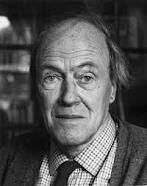
Roald Dahl, 1916 - 1990
(c) Orla Shanaghy 2011
Gestation of a short story #5: First draft, first draft, first draft!
Events (in real life) intervened since I last posted an update on the progress of my short story. The result was that I wrote nothing for six days. It’s difficult to resume a writing project after a gap. You’ve lost some of the closeness that you had with your characters, your head is not in the right place any more, you are no longer “in the zone”.
Having said that, these things can all be regained. I sat down when the house was quiet, pretending not to notice the towering piles of papers on my desk waiting to be sorted out (an essential writerly skill), and closed my eyes. (If anyone had been watching, they would have assumed I was having a little nap.) The story re-formed itself in my head, the characters came back, and I was in business again.
It’s great to be back writing; as Ray Bradbury says in Zen in the Art of Writing, “An hour’s writing is tonic”.
And now…
I have a first draft!!!
Apologies to the exclamation mark police here, but I really feel I need them at this point!!!

I have a first draft!
Can it be that the six-day gap was actually beneficial to the story in some way? Does a break in writing allow characters, plot and the other elements of the story to develop unnoticed at the back of the writer’s mind?
Characters
I am fairly happy with how the characters have developed and consolidated. The short-lived siblings are long forgotten (God rest their souls) and the dynamics of the three-person family are working well. The character profiles that I completed at the beginning have really helped with the development of the story in my head. Each character seems to be doing what comes naturally; I haven’t found myself struggling, asking myself “What should be happening now?”
Timeline
The timeline has proved itself a trustworthy friend. I refer to it often for various reasons. For example, when one of the characters hums a song, I needed to check exactly when that character was born, so that I could research what songs were popular when he was growing up.
House plan
As for the house plan that I sketched at the beginning, it is looking a little well-thumbed by now. I have referred to it many times to figure out the characters’ movements around the house.
Light at the end…
For some reason that I suspect it would take a psychologist to figure out, I put off writing anything to do with the ending until the last possible moment. OK, let me hazard a guess.
In a short story, the ending is a big deal, the big kahuna. It brings everything in the story together and “wraps everything up”. By this I do not mean that the ending has to explain things or bring everything to a conclusion – far from it. A short story may end with nothing much having happened. What I do mean is that the ending puts the stamp on the story that the writer wants it to have. As Nancy Kress points out in Beginnings, Middles and Ends, the ending may be the climax of the short story (unlike in the novel, where the climax comes somewhere near the end, followed by a denouement). So writing the ending feels a bit like heart surgery: mess it up, and the whole thing is gone.
I’m also aware that in previous short stories of mine, the endings sometimes tended to drag on. A creative writing teacher of mine (I think it was either John F. Deane or Mark Roper, both outstanding writing teachers I have been lucky enough to learn from) made me aware years ago of the need to put a quick, clean end to a short story.
In the case of this story, the original anecdote on which the story is based pulled me towards one kind of ending. As I started to write the last few paragraphs, another ending began to form in my head. So I wrote two different endings. Now I just have to decide which one to use in the final version, keeping in mind the need to “get out quick”.
To do
So, I am really happy that the story is nearing completion. The final few things that I need to do are:
- Iron out some background details about the time period in which the story is set
- Decide on the ending and get out quick
- Check that the imagery is consistent and balanced. In terms of the five senses, this story is mainly oriented around sight and hearing; the readers see the main character’s world through his eyes and ears.

 Orla Shanaghy's blog - Wait til I tell you