Category Archives: Writing
Author interview: Derbhile Dromey, author of The Pink Cage
Derbhile Dromey‘s first novel, The Pink Cage, was published in June 2011 by Book Republic. Derbhile is a full-time writer with many strings to her writing bow: fiction, journalism, editing, and creative writing teaching. She is also keen to help other people achieve their writing dreams and is launching a Prepare to Publish Service, offering manuscript evaluations and lists of places to send manuscripts.  Orla chatted to Derbhile about getting published as a new writer, the pros and cons of working with a “non-traditional” publisher, and the best ways for new writers to promote themselves and their work.
OS: Derbhile, congratulations on the publication of The Pink Cage. The book is published by Book Republic, a small, new, non-traditional publisher. How did you establish contact with this publisher? Can you describe the steps leading to publication of your book?
DD: I finished the book in May of last year and immediately started sending it out. I began with Irish publishers and agents, then moved to British agents and publishers who took email submissions. I then hit a wall because most of the publishers and agents required SAEs and Irish post offices don’t supply International Reply Coupons that the publishers and agents could use as stamps. But most were happy to reply when I explained this.
I had a total of 27 rejections before I found Book Republic. I had fully expected to get at least 30. After a ‘positive rejection’ from a British agent who had taken the time to write an encouraging note with her form slip, I had a spurt of energy and went onto the site www.writing.ie, a new resource for Irish writers, which had a list of current publishers. I had been thinking that a small, independent publisher would be a good way to go. They would bear the cost of bringing out the book and I was willing to promote it. Book Republic were listed on writing.ie. I submitted to them and three days later got an email to say they were interested.
OS: There can be a negative perception around the financial rewards for writers, especially new writers, who work with the more established print publishers. Book Republic describes itself as a “boutique publishing press” that “was set up to combat the traditional model of publishing”. How have you as a writer found working with this kind of publisher? Do you think the financial rewards for the writer can be greater with a non-traditional publisher like Book Republic?
DD: The advantage of going with a publisher like Book Republic is that you get to keep more of your money. Royalties are better than with traditional publishers. And you get more autonomy over your book. You can decide on your cover and you get a strong say in the editing process. They also distribute books on a Print on Demand basis, which means that a book is only printed when someone orders it. This means no returns and less likelihood of ending up on the bargain pile. They also automatically produce an ebook version of the book at the same time, which gives me a chance to avail of the growing ebook market.
But the disadvantage of that is that it’s proved impossible to get it into the bookshops. People can order it in bookshops, but most bookshops won’t stock it because they use the more traditional distribution channels. And despite all the talk about high figures for buying over the Internet, a lot of people still expect to stroll into a bookshop and pick up a book. So this has meant that the book isn’t as visible as I’d like.
OS: The Pink Cage was released in print and electronic format simultaneously. How do you feel about having a published e-book? Is it something you would encourage other authors to do? Do you think having a book out in electronic format as well as print is a positive thing in terms of sales?
DD: I was interested in Book Republic because I felt that they would help me tap into the growing trend for people to buy ebooks. I think Book Republic are ahead of the curve. They publicise and sell largely over the Internet, but a lot of people still live in the world of paper books, including myself. I’m looking forward to seeing how the ebook phenomenon develops over the next few years and hope that I’ll benefit from it.
OS: You marked the release of The Pink Cage with book signings and launches. Can you tell us a little about the “real-world” publicity side of a new book: How important are launches and signings for new authors? Did you organise the events yourself? How much of that kind of in-person publicity do you think a newly-published writer needs to do? Do launches and signings have a noticeable effect on book sales, or is their effect more general in terms of profile raising?
DD: The launch and signings were hugely beneficial. Book Republic do a small print run of 250 copies to mark a launch. They decided to print mine in hardback and all the copies were sold out at the launch and two signings. It’s hugely beneficial to do real-world publicity. And traditional media proved to be extremely effective in publicising the launch in particular. Book Republic organised the launch and I organised the signings. So in all, I would say they’re extremely important. The Internet is great, but it’s too easy for your book to get lost in cyberspace. Nothing beats that real-world connection with readers.
OS: You are active in the online and social networking worlds. Social networking can be hugely useful for creating a buzz around a newly-published work. How have you leveraged social networking for the publicity around The Pink Cage?
DD: Twitter has helped me to find people to blog about the book and Facebook has helped me to communicate with potential customers. I have a page for the book on Facebook, www.facebook.com/thepinkcage and a profile on Twitter @ThePinkCage.
OS:You also have your own blog and you do guest blogging on other sites. In your experience, how can blogging be used to publicise a published work?
DD: Blogging is more about giving useful information and creating a profile for yourself as an expert. It’s a complement to other social media activities.
In the end, you need to adopt a multi-pronged marketing approach, with traditional media, social media and word of mouth working in combination.
OS: In your experience, is there a specific period of time post-publication after which publicity efforts are no longer effective in terms of sales of that particular book – e.g. six months, a year?
DD: I’ll know more after Christmas!
OS: I know that you are also an active networker in the offline world. How important is real-world networking for writers? Do you have any recommendations for fledgling writers in terms of what they can do in the real world to promote themselves and increase their profile?
DD: Networking can be tricky for writers, since they tend to be quite reserved. But going to festivals and short courses are a good idea, because you meet like minded souls and you’re brought together by your work. Your priority has to be your work, but it’s important to step out of your cocoon and freshen your mind through contact with other writers.
OS: Derbhile, thanks for stopping by Wait til I tell you and enjoy the rest of your blog tour!
The next stop on Derbhile’s blog tour with The Pink Cage is tomorrow with Sian Phillips at www.sianphillips.ie.
The Pink Cage is available from the following outlets
Amazon.com/.co.uk, http://amzn.to/mPbKqO
Ebook: http://www.amazon.co.uk/The-Pink-Cage-ebook/dp/B0055PDNKO/ref=sr_1_2?s=books&ie=UTF8&qid=1315832405&sr=1-2 (paperback book can also be found here)
The Book Depository, http://www.bookdepository.co.uk/Pink-Cage-Derbhile-Dromey/9781907221248
Book Republic website, http://www.bookrepublic.ie/books-p/188-the-pink-cage
Gestation of a short story #4
Day 6
Thanks to the commenters on yesterday’s post for their advice and encouragement. I got stuck into my story again today with renewed enthusiasm and a calmer demeanour, and have gone from looking like this:

…to this:
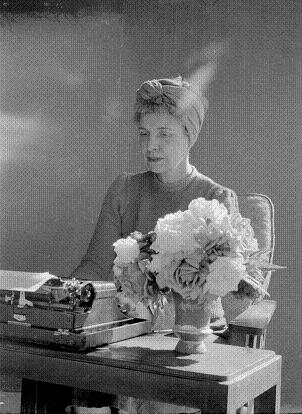
🙂
Time period
I have decided to keep the story in the 1950s because:
- Some of the key words in the story, words that were included in the original anecdote and sparked my imagination, are specific to that era.
- Setting up a small shop in your own home is much less likely to happen nowadays (planning permission laws are much stricter, and new small businesses less likely to get financing).
- If I can pull it off, the non-contemporary setting adds interest to the story.
Timeline changes (again)
I realised that the mother needed to be older. Based on the previous timeline, she had been only 18 when she opened her shop. I decided she needed to be a little older when she took this step. Also, now that there is only one child, I wanted to create extra space in the timeline, leaving the reader free to guess that there may have been miscarriages, as a possible reason for there being only one child in the family. Here is version 3 of the timeline:

Time scope
The next issue I was dealing with today was also to do with time. Originally, I had thought that as well as the action that takes place in the story present, the story would include scenes from the past as background. Now I think that this time scope is too wide for a short story – for this one, anyway. I am going to keep the story within the limits of a few hours on one day. I am really trying to keep this story as tight and focussed as possible.
Development of the main character
The character of the boy is filling out. His new status as the only child has made him more self-assured although he still has the searching, watchful nature. The idea is still that the parents are very busy, so he is still always striving for time with and attention from them.
I have written just under 400 words of the actual story. This is a bit discouraging after six days.
A more encouraging thought is that a large part of the planning is complete. Now that I have quite a clear idea of the shape and sound of the story, further changes can be made as I write.
Gestation of a short story #3: Dark night of the soul
Days 4 & 5
Things are not going too well.
Maybe it’s divine retribution. I am guilty of infanticide: I have had to kill off the three siblings. As per my previous post, the number of characters in a short story has to be kept to the minimum. So the siblings’ lives have been cut short before they even properly started and my main character is now an only child. Sniff.
This changes the whole dynamics of the family and the character profiles have had to be amended as well. The mother’s energy now comes in part from a need to keep herself busy, to fill the gap in her life left by the absence of any more children.
The father-son relationship has also changed. Now that the boy is the only son, he is destined to take over his father’s family business. There is now an air of expectation and pressure in their interactions, especially as the boy is a reflective, bookish character and does not fit his father’s idea of the kind of person needed to take over the business.
Just as well I hadn’t got around to the doing the main character’s detailed profile yet – I can start that from scratch with him as an only child.
With all that in mind, I set about re-drafting the timeline earlier today. I was busy crossing out the hapless siblings and considering how to close the resulting gaps when a thought occurred to me. Is it really necessary for the story to be set in the 1950s?
The anecdote that originally sparked the idea for the this story took place in the 1950s, and I guess I just left that in in my initial planning. But does this really add anything to the story? Could it just as easily take place in the now?
Also, transposing the story to the present would remove the burden of historical accuracy (and the research work involved for me). (I could just go and ask the person who originally told me the anecdote for details about the period, but I don’t want this to be anything remotely resembling someone’s memoirs; the anecdote is simply the spark for a work of fiction.)
One step forward, two steps back. I’m starting to wonder if this story has as much potential as I originally thought.
Gestation of a short story #2
Day 3
Character profiles – mother and father
I spent a good portion of my writing time today developing the characters for the story.
The main character is the third child in the family, a boy, aged eight. The story is told through his eyes, in the third person. The mother and father are the two other significant characters.
I got the character profiles for the mother and father done today. They ended up being longer and a bit less structured than previous profiles I have done, but I got into a good flow and didn’t want to interrupt that! There is a lot of detail in them, which I hope will enhance the characters. The vast majority of the detail will not feature in the story, it is just background information for me to keep in mind and refer to as I write. I certainly feel as if I know these people well now.
Here is an abridged version of the character profile for the mother:
Mary, born 1925 into a large family, several children. Grew up in the countryside outside the town she now lives in. The town seemed remote and exotic. Her parents kept a few cows, grew their own potatoes, did what they could – her own mother kept hens, sold eggs, took in mending, etc. Mary was one of the older children and worked from a young age, cooking, cleaning and minding younger children. She moved into the town aged 16 to work as a domestic in a guest house. Her cleverness and capacity for hard work were quickly noticed and she was soon offered a job as a shop assistant in the town’s largest grocer’s shop. She made lots of friends in the town and settled in quickly to her new life there.
At age 18 she met Tom Loughlin when he came into the shop one day. She fell for his charm and wit. As the only son he was expected to take over his father’s business in due course. Because Tom’s family had means, lack of money did not delay their plans and they married later the same year. Tom’s father helped them buy a house that came up for sale on the main street in the town. Mary is delighted and feels she has truly escaped the hardships of her childhood.
Mary gives up her job in the shop when she marries. There is an expectation that she no longer needs to work and she sees no reason to disagree initially. However after a few months of “keeping house” in her new home, she is bored and starts to think about how to occupy herself. She loves Tom as much as ever but has noticed that his business and management skills are not as keen as hers. His building business ticks over but does not do as well as it could. This annoys her and she also realises that extra money coming into the house would not hurt.
Mary decides to open a tiny grocery shop, operating from the front room in the house. Being an end of terrace house, there is a side door from which the shop can operate without putting in on the household too much. She persuades Tom to give the idea his blessing. She has found her calling: businesswoman. She knows that Tom is a little put out but her ambition and conviction drive her on. She also knows that Tom adores her and despite grumbling, will always support her.
As she settles into motherhood, Mary finds that with help, organisational skills, and her great energy, she can keep running her shop and begins to plan for expansion…
One other thing about the character aspect: I am not too clear at the moment about how I will handle the siblings in the family. It is central to the story that the family be a large one, so I have settled on four children. However, this being a short story, three main characters is pretty much the maximum (unless you are Kevin Barry – his story “Beer Trip to Llandudnow” in New Irish Short Stories has six equally important, perfectly drawn characters – but that is Kevin Barry). So I don’t want the other siblings to be prominent. At the same time, they have to be proper characters and not one-dimensional “devices”.
Timeline version 2
The other thing I did today was expand the timeline. Here it is now:
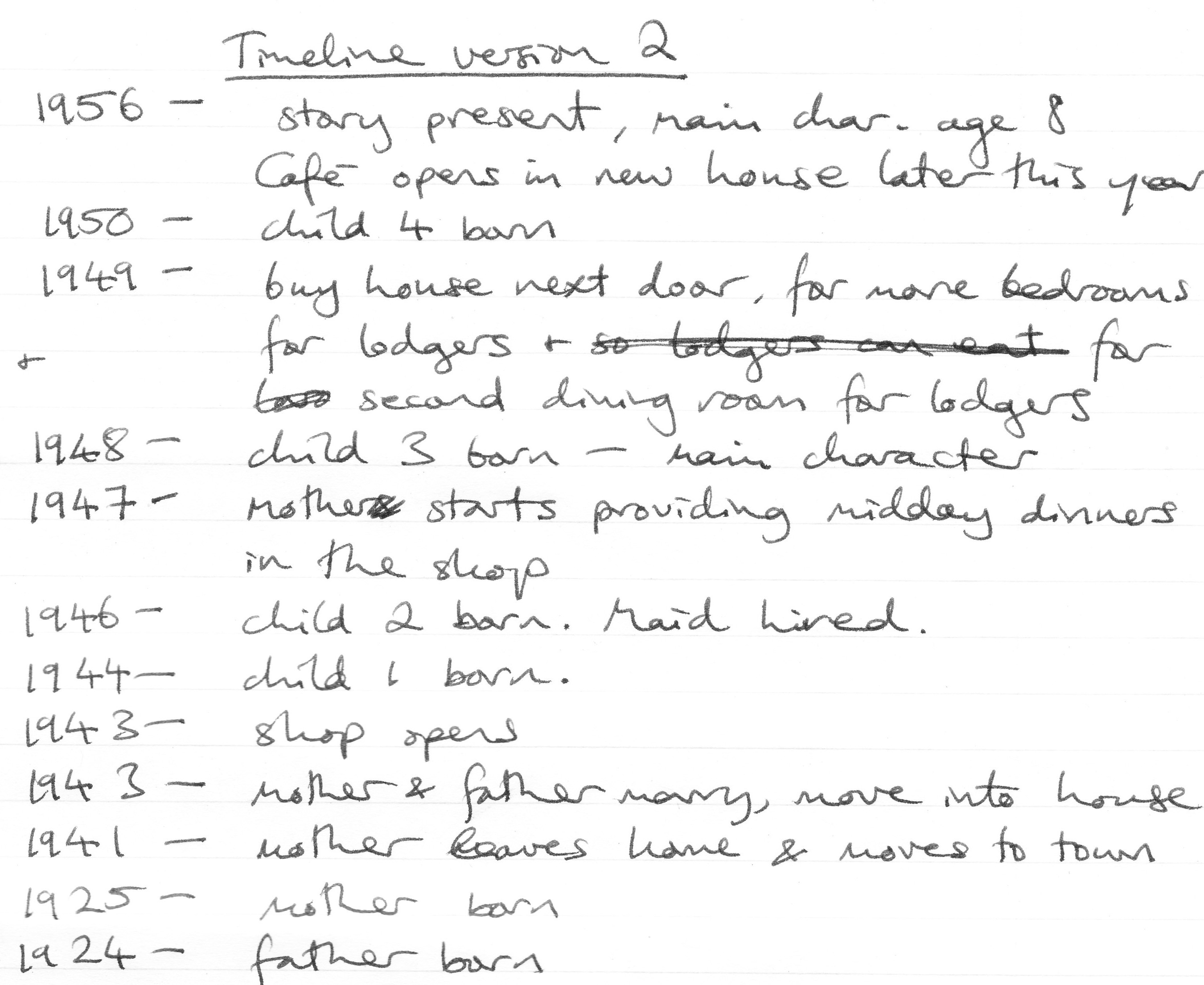
The timeline needs refining but I am not going to change it again until more of the story is written. Once I see how the characters are developing on the page, I will be able to see more clearly how the time aspect is panning out and revise the timeline as required.
Possible key scenes
I’ve worked out three key scenes so far. Number 1 below will be placed towards the end of the story. Originally I had thought of this scene as the “climax”, but this is too strong a term in a story like this where the action takes place largely in the main character’s head. “Epiphany” is likewise not quite right. It’s too dramatic. What the main character in this story experiences is more of a quiet realisation. So a better term in this case is “turning point”.

This is another key scene and the resulting first draft of a paragraph I have written for it:

It’s dinner time. Bacon and cabbage for the lodgers. Mammy spins between kitchen and dining room, steaming plates held high. He retreats, going right to the back of the house on the top floor, but the smell is everywhere. His parents’ muffled voices float up from the kitchen, in the rising inflections of an argument. There is a moment of silence, then the stomp of angry footsteps. Banging. He follows the noise downstairs, through the door through to the new house. His father stands at the foot of the stairs, one hand at his brow, the other resting on the sledgehammer, a pile of splintered wood at his feet.
He knows to ask his father only specific questions.
“Why are you breaking the stairs, Daddy?”
His father closes his eyes slowly.
“So Mammy can make her cafe.”
What’s next?
- Create a character profile for the main character
- Figure out background characters (siblings) – check creative writing books
- Decide on a title for the story – in a short story, the title is crucial
- Write the opening paragraph
Gestation of a short story #1
What are Greenday talking about? I love September. With the exception of going back to school (which only bothers you if you actually have to go – teehee), September is a time of renewal, revival and getting around to things you put off til after the summer holidays.
In that spirit, over the next while, I will be tracking the development of my latest short story as I write it.
This story-to-be was inspired by that rich source of short story material: a passing comment, an almost-anecdote. The one I have in mind was told to me by someone I know, at least a year ago, on the subject of his childhood. There was an image in there that has stuck in my head ever since: A mother, father and their children are driving along in their car. The mother and father have had a row at home. Suddenly, the mother begins to sing happily.
What intrigues me about this little vignette is what it might say about the dynamics of family life and married life from a child’s viewpoint. Children can be highly perceptive and they can also misinterpret and over-interpret. How might one of the children interpret what is going on in this family on this day?
This series of blog posts tracks my efforts in building this story. Whether or not the story is a success (see how I’m covering myself there?), I hope it’ll be of interest to some to follow the process a writer can go through in an attempt to create a short story (obviously, there are many ways to do this – mine is only one).
***
Days 1 & 2
Physical environment – house sketch
After mulling over various possibilities for the story for a while, I develop a picture of the family at the centre of the story. The family – mother, father, and three or four children – lives in a big, chaotic house in a medium-sized town. The family’s life revolves around their shop. The small grocery shop is integrated into the house in the converted front downstairs room.
Part of the dynamics of the story is that the mother in the family runs several mini-businesses from within the home. The house is always being extended and modified to make room for each new business venture. So the house is always noisy and busy.
I realise that movement and the physical environment – all the family members moving around this big, chaotic, disorganised, confusing house – are key to the story. So I decide to sketch out a plan of the house. I want to be completely familiar with the layout of the house in my own mind, so that the characters’ movements around the house are consistent and flow smoothly.
This is my initial sketch (architects and technical drawing experts, look away now!):

Timeline
At this stage, the characters are still in their infancy in terms of development. Later, I will create detailed character sketches. Before that, I need to create a timeline for the family in the story. This is to ensure that all aspects of time in the story are correct and consistent. For example, to specify the age of each character, I need to know when they were born, and all the family members’ dates of birth have to be consistent with each other.
This is the rudimentary timeline I drew up (yes, on the back of an envelope – keeping it real!):

Practise paragraphs
By this stage (the end of day 2), I have also written a few disconnected paragraphs of the actual story. These are really sketches themselves, rough “practise” drafts to help me get an idea of how the story might look and sound.
What’s next?
The next steps are: fill out the timeline, create detailed character profiles, and identify key scenes. I’ll be moving forward with these tomorrow.
Author interview: Maria Moulton, author of "Mammy Diaries"
Maria Moulton is the author of the just-published Mammy Diaries, a fascinating, in-depth look at pregnancy and motherhood in modern Ireland based on almost three years’ worth of interviews with Irish mothers. Published at the end of March, Mammy Diaries has already received a level of publicity in both old and new media that is remarkable for a self-published work.
I recently caught up with Maria at the Waterford launch of Mammy Diaries and asked her for her insights into self-publishing and self-promotion.
Mammy Diaries
OS: Maria, first of all, congratulations on your remarkable book, Mammy Diaries. It’s the first book that I’m aware of that really lifts the lid on what motherhood in 21st-century Ireland is like. How are you finding life as a published author so far?
MM: Thanks Orla! Well, to be perfectly honest, I’ve just swapped the busy-ness of being a stay at home mother trying to squish in time to research, write and compile a book, for the busy-ness of being a stay at home mother trying to squish in time to promote, sell and publicize a book! It’s been great fun though. I still can’t believe that it’s “out there.”
OS: Mammy Diaries is a self-published work. Did you decide to self-publish from the word go or did you consider approaching traditional print publishers first?
MM: From the start, I really liked the idea of self-publishing. Aside from the obvious benefits of working at my own pace (essential with small kids!) and having complete control over content, I also knew that the book I was putting together had a very specific audience and as such would be a lot easier to publicise then if say, I’d written a work of general fiction.
My husband was a bit nervous about the idea at the start, so for his sake I did send out a few letters of enquiry to a few traditional publishers. I never even got past the proposal stage with them, so in the end, it was self-publishing all the way! I decided to go with a company in Dublin called Original Writing and they’ve been absolutely amazing. A real pleasure to work with and very efficient, every step of the way.
OS: The publicity around the book has already been fantastic – radio slots, newspaper pieces, online PR, and your ongoing nationwide book tour. The book is also on the shelf in Easons’s, which is rare for a self-published work. How have you gone about generating publicity for the book?
MM: As you said yourself, self published works don’t tend to get into the larger, mainstream book shops, so my main goal when Mammy Diaries was published was to generate as much publicity in as short a space of time as humanly possible. The ide was to make it that much more attractive to the bigger retailers. This meant contacting journalists who I thought would be interested in the project, getting exposure in both local and national media and once I’d gathered enough clippings and podcasts, my publishers in Dublin contacted the bigger shops and “Voila!”.
The Internet has definitely been my biggest and most effective tool. Without it, the book probably wouldn’t have been written and I’d never have even considered self-publishing without it. You can do anything online. IrishPressReleases.ie allows you to contact the nation’s media in seconds and social networking sites like Twitter, Blogspot and Facebook have just opened up so many doors. It’s amazing really how far we’ve come in the last 10 or 15 years.
OS: Which channels are you finding the most effective so far for promoting your book?
MM: Well, the press coverage at the start was a huge boost . That definitely brought the book to the public’s attention. Having it in Eason’s is great because it means that it’s easily and constantly available to people. The book tour allows me to help keep the book current and to continue to introduce it to people who may not have heard about it yet. Obviously though, as I said above, it’s the internet that’s making it all happen.
OS: Mammy Diaries is currently out in print format. E-reader platforms like Kindle can bring self-published books to a much wider audience. Have you any plans to also publish Mammy Diaries for e-readers?
MM: My husband is working on it at the moment! Touch wood, it should be available in Kindle format in the next week or so.
OS: Self-publishing used to be the Cinderella of the book world. Some sources now say it’s the next big thing. What is your view of self-publishing versus the more traditional route of submitting your work to established publishers and hoping for the best?
MM: Honestly? I love it. I think that if you have the drive to get out there and put in the work to promote your book, it’s definitely worth considering. No one is going to work as hard for your book as you are. I know I’m probably sounding like a bit of a broken record, but the internet really has opened up so many doors and possibilities.
That being said, it’s called self-publishing for a reason. You are your own editor, critic, agent and publicist, and that can get a little tiring. You’re not going to feel one hundred per cent all the time and there are going to be days when you wish to God that there was a team of people behind you organizing everything for you and telling you exactly what to do next. You are going to have moments of self doubt where you wonder “Is it really any good at all? What have I done?!”
At the end of the day though, you get to put out exactly what you want to put out and not someone else’s version of what you started off writing. Hopefully, with a little luck and a lot of work, you’ll find a group of readers who connect with what you’ve written and who will look forward to hearing more from you.
OS: For many writers, their work is a labour of love. But money is key to being able to continue as a writer. Can you talk to us a little about the financial side of a venture like Mammy Diaries – did you have to invest much of your own money into getting it published and to publicise it? Do you expect to make a profit on the book?
MM: The cost of publishing varies from company to company and package to package. With the different self-publishing companies that are out there (and there are more popping up every day) you can look at paying anywhere from 1000 euro for your basic, no-frills option to several thousand euro which will buy you editorial services, consultation on cover design, and so on.
Not being made of money myself, we went for something on the more basic end of the scale publishing-wise. Aside from the cost of petrol, all of our publicity has been free, so for us there really wasn’t that much of an investment to be made.
Aside from that, we’ve just worked really hard to do as much of the grunt work as we could do ourselves. My husband learned how to do web design so he could do my website and we also designed the cover ourselves. I have a regular (if currently neglected!) blog of the same name, a Facebook group for Mammy Diaries as well as a Twitter account that I’m getting better at using. Whenever we go anywhere to do signings, I let the local media know in case it’s something they’d be interested in covering. None of this costs money, just a bit of time and effort.
I’m also lucky enough to be surrounded by a large group of friends and family who are unbelievably supportive of Mammy Diaries and do their best to promote the heck out of it, for which I’m eternally grateful!
OS: You’re currently on a nationwide book tour. How are you finding the tour? Would you recommend a book tour to other writers as part of the PR campaign for a self-published work?
MM: Definitely. It’s a great oppurtunity to meet the people who will be reading your book as well as to make contacts with book shops and libraries. Also, every launch gives you the potential for local media coverage, which is great for keeping your book in the public eye.
OS: I’ve been told that self-promotion can take as much time as writing itself, if not more. How do you go about making the time for promotion work for Mammy Diaries? Do you have any tips for other writers in this regard?
MM: Do your best to do the kind of promotion that works for you. As a mother of two small children, traditional evening champagne launch events didn’t work for me (or for that matter, for the majority of my audience!). Instead, we hold our signings in play centers where my girls can run around and play with other children and the mothers who are coming along can do the same and not have to worry about babysitters and such. The same goes with radio and print interviews – most of mine were done on the phone so I could do them from anywhere. I spoke with The Irish Times from the car while we drove around the countryside putting the girls to sleep and I did an interview with a Waterford radio station live from my kitchen in my pyjamas!
My husband was made redundant last year, which ended up being a blessing in disguise as it was his being home that gave me the freedom to really buckle down and get the last of the book finished. He’s also my chauffeur/graphic designer/web master and general go-to guy.
Aside from that, I fully admit that there was a LOT of procrastrination in the way of Facebooking, tweeting and emailing going on while I was writing Mammy Diaries. Nowadays, I use that same time to do the same things, but with a purpose. Instead of a way to procrastinate, I’m using them for promotion instead.
OS: Many thanks Maria!
***
Find Maria at http://www.mammydiaries.ie, http://mammydiaries.blogspot.com, on Facebook at Mammy Diaries Ireland and on Twitter at @mammydiaries.
(c) Curmumgeon 2011
Douze points for Denise
Things may not have gone quite as hoped for Jedward in the Eurovision, but Denise Quinn’s performance in Garter Lane theatre in Waterford on the same night, May 14th, won a standing ovation and a resounding douze points from the packed audience.

Denise Quinn, author and sole performer of "Bardot Bites" and "Lucy Bastible"
Local woman Denise is the writer and sole performer of two one-act, one-woman plays, Bardot Bites and Lucy Bastible, which ran for two sold-out nights in Waterford last week as part of a nationwide tour.
The plays are beautifully observed glimpses into the lives of two very different women. Denise’s scripts cleverly use humour to draw in the audience and make them feel an instant connection to two women at crisis points in their lives. “Bids” in Bardot Bites is a single, middle-aged, put-upon woman determined to get her life back on track after her elderly mother’s death, while Lucy Bastible is refined, well-off wife of a solicitor who unleashes her wild side after her husband’s infidelity.
While the script is sharp, witty and insightful, it is Denise Quinn’s acting skills and stage presence that made this performance truly wonderful. We, the audience, genuinely forgot that there was only one person on stage. The stage seemed to teem with characters – Leonie and Leandra, Bids’ two young, man-mad colleagues at the cheese counter in the local deli, were particularly brilliant. Denise’s depictions of the ridiculous situations in which people find themselves in daily life were a joy to behold (one scene involving a balcony bra and a roving hand in the cinema will stay in my mind forever).
The script is also a great example of that great maxim of creative writing: “Write what you know”. Not content with being an accomplished playwright and actress, Denise is also a qualified solicitor and sales assistant at a well-known cheese counter in Waterford. Both cheese and the legal world featured strongly in the scripts and the playwright’s background in both greatly added to the credibility of the plays.
Accolades are also due to the show’s director Mary Curtin, a high-profile name in Irish theatre with a long list of theatre and film credits.
Bardot Bites and Lucy Bastible went down so well on the Cork leg of the tour in April that Denise has been asked to give repeat performances there later in the summer. Let’s hope she can be convinced to do the same in her native city at the earliest opportunity.
A miscellany of magic
Even in this internet age – or maybe especially in this internet age – the printed word is still loaded with magic.
I’m beyond honoured to be included in the new RTÉ Sunday Miscellany Anthology 2008-2011, edited by Clíodhna Ní Anluain and published by New Island. Sincere thanks to Clíodhna, editor of RTÉ’s Sunday Miscellany, for finding a slot for my piece, A Tribute to Mick Lally.
I also had a completely magical evening on April 7th at the launch of the book in the National Concert Hall, Dublin. It was great to meet Clíodhna and Miriam O’Callaghan, who launched the book and said some very nice things about it. It was also really special to chat to Padraig O’Neill, award-winning production designer, who was a close friend and colleague of Mick Lally’s (including on Mick’s last screen turn in the recently-released Snap) and has some wonderful stories from their times together.
The launch was followed by a wonderful Easter Sunday Miscellany concert, with readings from the book by Kevin McAleer, Mary Molloy, Grace Wells, and Kevin Barry, among others, interspersed with music from artists including Altan, Eimear Quinn and the RTÉ Concert Orchestra. The concert was broadcast in the Sunday Miscellany slot on RTÉ Radio One over the last two weekends. Here are Part One and Part Two.
The text of my piece in the book, A Tribute to Mick Lally, is here.
Lines Penned On the Occasion of the Epiphany
I wrote this a few Christmases ago. A bit of light-heartedness seems especially appropriate now as 2010 draws to a close. Remember, it’s for a giggle, people – no disrepect intended to anyone of any religion! Merry Christmas everyone!
Lines Penned On the Occasion of the Epiphany
In olden times – nay, yesteryear,
Or perhaps it was days of yore,
Three Irish men sat down to plan
A trip to a far-flung shore.
They’d heard Our Lord had just been born
And they just had to see Him first-hand
They settled it over a couple of pints
They would head for the Holy Land.
Frankie Malone was the brains of the group,
He would sort all the travel and visas,
While PJ O’Brien would make sure to sort out
Some gifts for the baby Jesus.
PJ and Frank knew that Willy Magee
Was a few bricks short of a load
So to give him a job, they put him in charge
Of refreshments and snacks for the road.
They were finally ready, the boys set off.
The road was a hard one at first.
But their spirits were high and Willy had packed
Five slabs of Dutch Gold for the thirst.
In Damascus they met up with three fellas in turbans
Who claimed to be led by a star
Our heroes just shrugged – they were tolerant types –
And they asked them along for a jar.
Frankie and Co. felt guilty next morning
When their friends couldn’t move from their beds
But with no time to waste, they bid them goodbye
And left them there nursing their heads.
As they got nearer Bethlehem, matters improved
In terms of their method of travel
The locals stood back in amazement and gazed
At the three Irish lads on a camel.
In a field outside Bethlehem they had a wee session,
The end of the journey was near.
“And just as well too,” hiccuped Willy Magee,
“’Cos that’s nearly the end of the beer.”
“One last thing,” cautioned Frank, as he downed his last drop,
“We’ve a problem: our names are too silly.
They’ll laugh at us in Bethlehem if we say that our names
Are PJ, Frank, and Willy!”
“What were those lads called who we met in the bar
And left sound asleep in Damascus?
Oh yeah – Casper, Melchior and Balthazar,
We’ll just say those if they ask us.”
They set off and were just at the stable door
When O’Brien did let out a groan.
“The gifts for the babby – I got them, but lads –
They’re in the boot of me car back at home.”
“Here – divide up this stuff I bought in that bazaar,”
Said Frank, having thought for a minute.
“It was meant for the missus, but she’ll be none the wiser,
Sure I haven’t a clue what is in it.”
So they knocked on the door, and were welcomed inside,
They rejoiced at the Virgin Birth.
Then a shepherd regarded the gifts they had brought
And scornfully asked, “What on earth?”
“Twenty shekels that cost me!” said Frank, incensed.
“Mmm – errr…” said PJ, far from sober.
Then Willy produced his last can of Dutch Gold
And solemnly handed it over.
People heard far and wide of the three foreign men
And their strange tongue (some believed it was Greek)
And the gift they had brought for to worship Our Lord
(Even if it was somewhat – unique).
Only three weary Persians, not long back from a journey,
Declared there was really no mystery.
But no-one believed them how three Irish blokes
Stole their place in the annals of history.
End
© Curmumgeon 2010
A Tribute to Mick Lally, 1945 – 2010
The facade of the Forum theatre in Waterford looks down on a sloping plaza that is itself surrounded by the small terraced houses that mark this historic part of the city. Here and there between the houses run narrow streets with centuries-old names, some leading down towards the Quay, others up the town to Ballybricken and beyond. It was down one of these streets, as I stood outside the theatre after a performance of The Castlecomer Jukebox in 2004, that I watched a solitary, tall, hunched figure lope away, hands in pockets, probably off for a quiet post-performance pint in one of O’Connell Street’s pubs. That figure was Mick Lally.
I never had the good fortune to meet Mick Lally in person, but I cannot shake the feeling that I have known him all my life. To my brothers and me, like many Irish children in the 1980s, the Glenroe theme tune signalled the dreaded Sunday-night bedtime (as much as it probably signalled to our parents the time when they could finally sit down and watch some TV in peace). Even when we were too young to actually watch Glenroe, we and our schoolfriends knew all the characters and especially Miley, the beleaguered everyman with the bewitching voice and a brilliant catchphrase that we repeated with delight at every opportunity.
Being finally allowed to stay up beyond 8 pm on Sundays to watch Glenroe was a real rite of passage. As well as being a staple in that show, to those of us growing up in Ireland in the 80s, Mick Lally always seemed to be around, be it on TV or radio. He even managed to turn a TV ad for cheese into a memorable experience, his mellifluous tones combining deliciously with the thrumming of a bodhran’s beat.
The years passed, I moved to Dublin, and even though as a student I no longer had access to a TV, Mick remained a constant. My Austrian friend Sabine visited Dublin and to give her a taste of Irish theatre, my boyfriend and I took her to see A Skull in Connemara, with Mick in the lead role. We had great seats looking down on the stage. I remember being overawed by Mick’s looming, menacing presence in that role. I was also delighted that we had an actor of such calibre in this country that enabled me to show off our culture to a visitor so successfully. In the pub afterwards, Sabine’s English was tested to the limits as she tried to put into words the impression his performance had made on her.
These days, my husband and I, now with three children, rarely get to listen to an entire radio show, so it was a special treat on a recent drive to Dublin to turn on the radio and hear Mick’s voice. He and another wonderfully familiar actor, his Glenroe co-star Mary McEvoy, were being interviewed by Miriam O’Callaghan. As the children, miraculously, slept in the back, it was a delight to hear him describe his life and career with endearingly self-deprecating good humour, and just as much a delight to simply sit and listen to his voice. To hear his gorgeous spoken Irish was another pleasure.
Perhaps because that interview is so recent, the news this morning comes as a particularly sad shock. It strikes me that as we advance into our mid-thirties, us Glenroe children have now reached the age where the death of a well-known person can feel like the death of something in us. Mick Lally was part of the background of our lives, whether we paid his presence there much heed or not. Now that he is gone, I personally, for the first time, feel the loss of a person I never actually knew.
Although, thanks to that radio interview, it is not long since I heard him speak, my last, and lasting, visual impression of Mick Lally is that evening in Waterford in 2004, when I watched him walk away down a dark street after another brilliant performance, alone, seeking no accolades, a quiet master.
(c) Curmumgeon 2010

 Orla Shanaghy's blog - Wait til I tell you