Blog Archives

How long does overnight success take?
There is an inspiring new post by Rosie Lugosi on the Myslexia blog called “Hare / Tortoise”. In it, Rosie describes how her novel-writing career is finally taking off after twelve years of slog. The post has got me thinking about the cultural phenomenon of “overnight success”.
I have often mused about this with a friend who is also interested in the topic. We in the English-speaking world are obsessed with the idea of overnight success. It is the concept upon which talent shows like The X Factor are based: Someone is plucked from obscurity and thrust into the limelight on the strength of their amazing talent, which was just waiting to be discovered.

Mary Byrne on The X Factor
Mary Byrne and Susan Boyle are perfect examples. In the PR narrative that was presented along with them as they came to media prominence, both women (both undeniably very talented) had languished in obscurity for decades, their gift known only to their nearest and dearest, until Simon Cowell and co. swooped in to rescue them.
However, look a little more closely, and it emerges that both Ms. Byrne and Ms. Boyle had been singing for many years, and with some success, long before they went on The X Factor and Britain’s Got Talent, respectively.
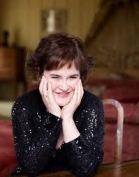
Susan Boyle, runner-up in Britain’s Got Talent
Mary Byrne had been a singer in her brother’s band and had actually won a singing content on Irish TV in 2008. Susan Boyle began singing in school productions at age 12, and she and her mother often talked about her possibly becoming famous. She sang for years in pubs and local competitions before The X Factor. In both cases, they had worked and grafted away for years. There was nothing overnight about it.
As an artist, I resent the overnight success concept. Anyone who has ever achieved anything worthwhile, ever, no matter in what field, knows that it takes graft, graft, and then more graft. Staying up til all hours, getting up at all hours, working when you could be out socialising, working when you could be spending time with your family… and you keep doing all these things for months, years and quite possibly, your whole life. That is what lies behind most creative success.
There are several examples in fields other than showbiz: Search engine behemoth Google and the ridiculously popular game Angry Birds both appeared to gain incredible popularity in no time, whereas in actual fact, both took several years’ steady, unremarked-on work on the part of their creators.
Overnight success is a myth, in all senses of the word.
Despite this, as a human being, I love stuffing my rational brain into a drawer and gorging myself on reality TV sob stories.
So why are we so in love with the idea of being suddenly “discovered” and catapulted to instant success?

Cinderella, before Disney got her
It has to be something to do with the Cinderella meme that is still so strong in Anglo-Saxon culture. We all love a good rags-to-riches tale, and the Disneyfied Cinderella, the version now most familiar to us, is the iconic one. After pining for years amongst the cinders, Cinderella is transformed into a beauty by her fairy godmother (or the spirit of her dead mother, depending on which version you read), goes to the ball, and after some token faffing about with glass slippers, marries the prince and lives happily ever after. This is the original overnight success narrative arc, now found in countless movies, books and TV shows, and we can’t get enough.
The key question is, of course: Which came first? Did something inherent in human nature lead to the creation and rise of the Cinderella meme, or was an original affinity with the idea of sudden success nurtured by the rising popularity of the Cinderella fairytale?
For my part, I don’t know. If anyone with expertise in sociology or cultural history can shed more light on the question, I’d love to hear your thoughts below.
In the meantime, all hail to Rosie Lugosi on getting her debut novel picked up by Harper Collins after she won last year’s Myslexia Novel Competition. Her overnight success took twelve years. I’m still hanging in there for mine. 🙂
The write advice
Well-known writers are always being asked, “What advice would you give to new writers?”
This question must fill writers with dread. For one thing, it is quite a responsibility to give advice that someone may actually act on. For another, it is even more of a responsibility give such advice publicly. For yet another, advice is a strange beast that can reveal more than is intended about the giver of the advice.
 Every week, in the “There are no rules” section of Writer’s Digest editor blogs, the author trails through the magazine’s archives, searching for writing advice from famous authors. The most recent list includes Harper Lee, John Steinbeck and James Thurber.
The article contains several contributions from famous and less famous writers, and is worth a read. Also, it’s fun to try to connect each piece of advice to the author’s personality (or persona).
Harper Lee’s contribution seems typical of the notoriously media-shy and no-nonsense author of To Kill a Mockingbird: “I would advise anyone who aspires to a writing career, that before developing his talent he would be wise to develop a thick hide”.
John Steinbeck and Carl Sandburg both take a subversive approach to giving advice:
“Beware of advice – even this” (Sandburg)
“Sorry – if I had any advice to give I’d take it myself” (Steinbeck)
My favourite is the single word provided by Robert Fuoss: “Write”.
If you have any favourite pieces of writing advice, from well-known or less-well-known writers, I’d love to hear them – just reply below!
Gestation of a short story #5: First draft, first draft, first draft!
Events (in real life) intervened since I last posted an update on the progress of my short story. The result was that I wrote nothing for six days. It’s difficult to resume a writing project after a gap. You’ve lost some of the closeness that you had with your characters, your head is not in the right place any more, you are no longer “in the zone”.
Having said that, these things can all be regained. I sat down when the house was quiet, pretending not to notice the towering piles of papers on my desk waiting to be sorted out (an essential writerly skill), and closed my eyes. (If anyone had been watching, they would have assumed I was having a little nap.) The story re-formed itself in my head, the characters came back, and I was in business again.
It’s great to be back writing; as Ray Bradbury says in Zen in the Art of Writing, “An hour’s writing is tonic”.
And now…
I have a first draft!!!
Apologies to the exclamation mark police here, but I really feel I need them at this point!!!

I have a first draft!
Can it be that the six-day gap was actually beneficial to the story in some way? Does a break in writing allow characters, plot and the other elements of the story to develop unnoticed at the back of the writer’s mind?
Characters
I am fairly happy with how the characters have developed and consolidated. The short-lived siblings are long forgotten (God rest their souls) and the dynamics of the three-person family are working well. The character profiles that I completed at the beginning have really helped with the development of the story in my head. Each character seems to be doing what comes naturally; I haven’t found myself struggling, asking myself “What should be happening now?”
Timeline
The timeline has proved itself a trustworthy friend. I refer to it often for various reasons. For example, when one of the characters hums a song, I needed to check exactly when that character was born, so that I could research what songs were popular when he was growing up.
House plan
As for the house plan that I sketched at the beginning, it is looking a little well-thumbed by now. I have referred to it many times to figure out the characters’ movements around the house.
Light at the end…
For some reason that I suspect it would take a psychologist to figure out, I put off writing anything to do with the ending until the last possible moment. OK, let me hazard a guess.
In a short story, the ending is a big deal, the big kahuna. It brings everything in the story together and “wraps everything up”. By this I do not mean that the ending has to explain things or bring everything to a conclusion – far from it. A short story may end with nothing much having happened. What I do mean is that the ending puts the stamp on the story that the writer wants it to have. As Nancy Kress points out in Beginnings, Middles and Ends, the ending may be the climax of the short story (unlike in the novel, where the climax comes somewhere near the end, followed by a denouement). So writing the ending feels a bit like heart surgery: mess it up, and the whole thing is gone.
I’m also aware that in previous short stories of mine, the endings sometimes tended to drag on. A creative writing teacher of mine (I think it was either John F. Deane or Mark Roper, both outstanding writing teachers I have been lucky enough to learn from) made me aware years ago of the need to put a quick, clean end to a short story.
In the case of this story, the original anecdote on which the story is based pulled me towards one kind of ending. As I started to write the last few paragraphs, another ending began to form in my head. So I wrote two different endings. Now I just have to decide which one to use in the final version, keeping in mind the need to “get out quick”.
To do
So, I am really happy that the story is nearing completion. The final few things that I need to do are:
- Iron out some background details about the time period in which the story is set
- Decide on the ending and get out quick
- Check that the imagery is consistent and balanced. In terms of the five senses, this story is mainly oriented around sight and hearing; the readers see the main character’s world through his eyes and ears.
Author interview: Derbhile Dromey, author of The Pink Cage
Derbhile Dromey‘s first novel, The Pink Cage, was published in June 2011 by Book Republic. Derbhile is a full-time writer with many strings to her writing bow: fiction, journalism, editing, and creative writing teaching. She is also keen to help other people achieve their writing dreams and is launching a Prepare to Publish Service, offering manuscript evaluations and lists of places to send manuscripts.  Orla chatted to Derbhile about getting published as a new writer, the pros and cons of working with a “non-traditional” publisher, and the best ways for new writers to promote themselves and their work.
OS: Derbhile, congratulations on the publication of The Pink Cage. The book is published by Book Republic, a small, new, non-traditional publisher. How did you establish contact with this publisher? Can you describe the steps leading to publication of your book?
DD: I finished the book in May of last year and immediately started sending it out. I began with Irish publishers and agents, then moved to British agents and publishers who took email submissions. I then hit a wall because most of the publishers and agents required SAEs and Irish post offices don’t supply International Reply Coupons that the publishers and agents could use as stamps. But most were happy to reply when I explained this.
I had a total of 27 rejections before I found Book Republic. I had fully expected to get at least 30. After a ‘positive rejection’ from a British agent who had taken the time to write an encouraging note with her form slip, I had a spurt of energy and went onto the site www.writing.ie, a new resource for Irish writers, which had a list of current publishers. I had been thinking that a small, independent publisher would be a good way to go. They would bear the cost of bringing out the book and I was willing to promote it. Book Republic were listed on writing.ie. I submitted to them and three days later got an email to say they were interested.
OS: There can be a negative perception around the financial rewards for writers, especially new writers, who work with the more established print publishers. Book Republic describes itself as a “boutique publishing press” that “was set up to combat the traditional model of publishing”. How have you as a writer found working with this kind of publisher? Do you think the financial rewards for the writer can be greater with a non-traditional publisher like Book Republic?
DD: The advantage of going with a publisher like Book Republic is that you get to keep more of your money. Royalties are better than with traditional publishers. And you get more autonomy over your book. You can decide on your cover and you get a strong say in the editing process. They also distribute books on a Print on Demand basis, which means that a book is only printed when someone orders it. This means no returns and less likelihood of ending up on the bargain pile. They also automatically produce an ebook version of the book at the same time, which gives me a chance to avail of the growing ebook market.
But the disadvantage of that is that it’s proved impossible to get it into the bookshops. People can order it in bookshops, but most bookshops won’t stock it because they use the more traditional distribution channels. And despite all the talk about high figures for buying over the Internet, a lot of people still expect to stroll into a bookshop and pick up a book. So this has meant that the book isn’t as visible as I’d like.
OS: The Pink Cage was released in print and electronic format simultaneously. How do you feel about having a published e-book? Is it something you would encourage other authors to do? Do you think having a book out in electronic format as well as print is a positive thing in terms of sales?
DD: I was interested in Book Republic because I felt that they would help me tap into the growing trend for people to buy ebooks. I think Book Republic are ahead of the curve. They publicise and sell largely over the Internet, but a lot of people still live in the world of paper books, including myself. I’m looking forward to seeing how the ebook phenomenon develops over the next few years and hope that I’ll benefit from it.
OS: You marked the release of The Pink Cage with book signings and launches. Can you tell us a little about the “real-world” publicity side of a new book: How important are launches and signings for new authors? Did you organise the events yourself? How much of that kind of in-person publicity do you think a newly-published writer needs to do? Do launches and signings have a noticeable effect on book sales, or is their effect more general in terms of profile raising?
DD: The launch and signings were hugely beneficial. Book Republic do a small print run of 250 copies to mark a launch. They decided to print mine in hardback and all the copies were sold out at the launch and two signings. It’s hugely beneficial to do real-world publicity. And traditional media proved to be extremely effective in publicising the launch in particular. Book Republic organised the launch and I organised the signings. So in all, I would say they’re extremely important. The Internet is great, but it’s too easy for your book to get lost in cyberspace. Nothing beats that real-world connection with readers.
OS: You are active in the online and social networking worlds. Social networking can be hugely useful for creating a buzz around a newly-published work. How have you leveraged social networking for the publicity around The Pink Cage?
DD: Twitter has helped me to find people to blog about the book and Facebook has helped me to communicate with potential customers. I have a page for the book on Facebook, www.facebook.com/thepinkcage and a profile on Twitter @ThePinkCage.
OS:You also have your own blog and you do guest blogging on other sites. In your experience, how can blogging be used to publicise a published work?
DD: Blogging is more about giving useful information and creating a profile for yourself as an expert. It’s a complement to other social media activities.
In the end, you need to adopt a multi-pronged marketing approach, with traditional media, social media and word of mouth working in combination.
OS: In your experience, is there a specific period of time post-publication after which publicity efforts are no longer effective in terms of sales of that particular book – e.g. six months, a year?
DD: I’ll know more after Christmas!
OS: I know that you are also an active networker in the offline world. How important is real-world networking for writers? Do you have any recommendations for fledgling writers in terms of what they can do in the real world to promote themselves and increase their profile?
DD: Networking can be tricky for writers, since they tend to be quite reserved. But going to festivals and short courses are a good idea, because you meet like minded souls and you’re brought together by your work. Your priority has to be your work, but it’s important to step out of your cocoon and freshen your mind through contact with other writers.
OS: Derbhile, thanks for stopping by Wait til I tell you and enjoy the rest of your blog tour!
The next stop on Derbhile’s blog tour with The Pink Cage is tomorrow with Sian Phillips at www.sianphillips.ie.
The Pink Cage is available from the following outlets
Amazon.com/.co.uk, http://amzn.to/mPbKqO
Ebook: http://www.amazon.co.uk/The-Pink-Cage-ebook/dp/B0055PDNKO/ref=sr_1_2?s=books&ie=UTF8&qid=1315832405&sr=1-2 (paperback book can also be found here)
The Book Depository, http://www.bookdepository.co.uk/Pink-Cage-Derbhile-Dromey/9781907221248
Book Republic website, http://www.bookrepublic.ie/books-p/188-the-pink-cage
Tall Ships Festival 2011 in Waterford, part 1
 The thing I love about big public events like the Tall Ships Festival 2011, which kicked off in Waterford this afternoon, is that they take you out of yourself. They lead you to do things you wouldn’t normally do.
Sitting in Jordan’s pub on the Quay on a weekday afternoon, chatting away to total strangers, is not something I normally do.  Granted, I only ended up doing it today because it was the only way the daughter and I could find to escape the crush around William Vincent Wallace Plaza, where the formal launch of the Festival was taking place. We squeezed our way through the river of immobilised bodies, up the little flagged alley and in the side door of the bar. Five minutes later, the daughter and I were perched on red velveteen seats in the window, sipping lemonade, watching Keith Barry predict something amazing on the Plaza across the way (admittedly it did lose something with the lack of sound) and sympathising amiably with fellow street-refugees about the crush outside.
Once the crowds eased, the daughter and I were off again, doing a grand tour of the market on the Quay, gaily spending money on whatever took our fancy (because spending outside your budget doesn’t count on special occasions,  didn’t you know?), eating our own body weight in burritos, hotdogs and cupcakes (an unusual combination, I grant you, but hey, the Tall Ships only come every five years!) and dawdling deliciously with nowhere to be and no schedule to stick to.
When we’d seen and eaten everything we could, we decided to deal with the non-appearance of the bus by walking most of the way home. The Quay to Williamstown on foot was a joy: Strolling along in the late-afternoon sun, hardly a car in sight, daughter in a blissed-out world of her own with her iPod plugged into her ears and her hair dancing wildly around her face, the view of the City spreading out behind us as we advanced up John’s Hill towards Grange and home.
Now I’m sitting on my sofa, listening to the ship’s horns as they echo out from the Quay, across the City and out into the County, bidding us goodnight.
To close, a confession. Jordan’s is one of the most historic buildings in Waterford Ciy. I have often marvelled at it from the outside, at its cheeky sideways tilt and its faded, half-timbered glory. I was born and bred in Waterford. Until today, I never saw the inside of Jordan’s. Circumstances combined today to lead me there.
There are three more days to go of the Tall Ships Festival 2011. I can’t wait to see where it takes me tomorrow.
Guest blog post: Friends of Breastfeeding
Check out my latest guest blog article, this time for Friends of Breastfeeding: http://friendsofbreastfeeding.blogspot.com/2011/05/its-all-about-milk.html.
This is Waterford
One sunny morning last September, I was strolling down the river side of the Quay here in Waterford City. The air buzzed with conversation, shouts of laughter, and people calling out to each other. Mouth-watering aromas made the head practically swim. The car parks, emptied of cars for the weekend, were packed on both sides with market stalls piled high with every possible kind of food produce. It was the Waterford Harvest Festival 2010in full swing.

Reginald's Tower and Quay, Waterford
With all the negative news to hit our City last year, it would have been no surprise if visitors had found the atmosphere on the streets to be glum and muted. Instead, they found the people of Waterford engaged in what was basically a year-long party.
For me, like other locals, the hardest part was picking what to go to. It would have been physically impossible to attend everything.
There are some highlights that have stuck in my mind. A day in early July spent at Spraoi in the Park, when it seemed like the whole City and County was in the People’s Park, sitting on the grass in the sun, listening to the live music. My husband hoisting our daughter onto his shoulders to see and hear the drummers in Arundel Square at Spraoi a month later. My then-one-year-old kicking up her feet in delight at a “Baby Boogie” dance session with Libby Seward in Garter Lane as part of SprOg, the children’s pre-Spraoi festival. My older daughter and I joining in the dance moves to “Swing Low Sweet Chariot” that Rev. Bazil Meade, leader of the London Community Gospel Choir, taught the audience at a rousing concert at the Waterford International Music Festival in November. (We still do the moves when we think nobody is looking.)
There are too many other special moments to describe: “Seussical the Musical” in the Theatre Royal at the Waterford International Festival of Light Opera; Joseph O’Connor reading from his new novel at the Imagine Arts Festival; leaning against the wall across the road from Azzurro in Dunmore East on a Saturday afternoon in August to catch the music of the Jack Grace Band playing on the restaurant terrace at the Dunmore East Bluegrass Festival.
Now that we are almost half-way through 2011, with Ireland’s biggest ever open-air banner presiding proudly over the Quay, the excitement is palpable as the City gears itself up for the Tall Ships Festival 2011. It’s going to be some party.
Speaking of the Quay, I am reminded again of that morning last September. With the parked cars replaced by rows of market stalls and the place jam-packed with people, my seven-year-old was feeling a little disoriented. She looked up at me with a puzzled expression. “Mam, where is this?”
I could not help but smile as I gestured at the scene in front of us. “This is Waterford, love. This is Waterford.”
Douze points for Denise
Things may not have gone quite as hoped for Jedward in the Eurovision, but Denise Quinn’s performance in Garter Lane theatre in Waterford on the same night, May 14th, won a standing ovation and a resounding douze points from the packed audience.

Denise Quinn, author and sole performer of "Bardot Bites" and "Lucy Bastible"
Local woman Denise is the writer and sole performer of two one-act, one-woman plays, Bardot Bites and Lucy Bastible, which ran for two sold-out nights in Waterford last week as part of a nationwide tour.
The plays are beautifully observed glimpses into the lives of two very different women. Denise’s scripts cleverly use humour to draw in the audience and make them feel an instant connection to two women at crisis points in their lives. “Bids” in Bardot Bites is a single, middle-aged, put-upon woman determined to get her life back on track after her elderly mother’s death, while Lucy Bastible is refined, well-off wife of a solicitor who unleashes her wild side after her husband’s infidelity.
While the script is sharp, witty and insightful, it is Denise Quinn’s acting skills and stage presence that made this performance truly wonderful. We, the audience, genuinely forgot that there was only one person on stage. The stage seemed to teem with characters – Leonie and Leandra, Bids’ two young, man-mad colleagues at the cheese counter in the local deli, were particularly brilliant. Denise’s depictions of the ridiculous situations in which people find themselves in daily life were a joy to behold (one scene involving a balcony bra and a roving hand in the cinema will stay in my mind forever).
The script is also a great example of that great maxim of creative writing: “Write what you know”. Not content with being an accomplished playwright and actress, Denise is also a qualified solicitor and sales assistant at a well-known cheese counter in Waterford. Both cheese and the legal world featured strongly in the scripts and the playwright’s background in both greatly added to the credibility of the plays.
Accolades are also due to the show’s director Mary Curtin, a high-profile name in Irish theatre with a long list of theatre and film credits.
Bardot Bites and Lucy Bastible went down so well on the Cork leg of the tour in April that Denise has been asked to give repeat performances there later in the summer. Let’s hope she can be convinced to do the same in her native city at the earliest opportunity.
A miscellany of magic
Even in this internet age – or maybe especially in this internet age – the printed word is still loaded with magic.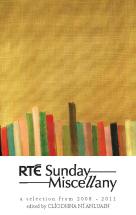
I’m beyond honoured to be included in the new RTÉ Sunday Miscellany Anthology 2008-2011, edited by Clíodhna Ní Anluain and published by New Island. Sincere thanks to Clíodhna, editor of RTÉ’s Sunday Miscellany, for finding a slot for my piece, A Tribute to Mick Lally.
I also had a completely magical evening on April 7th at the launch of the book in the National Concert Hall, Dublin. It was great to meet Clíodhna and Miriam O’Callaghan, who launched the book and said some very nice things about it. It was also really special to chat to Padraig O’Neill, award-winning production designer, who was a close friend and colleague of Mick Lally’s (including on Mick’s last screen turn in the recently-released Snap) and has some wonderful stories from their times together.
The launch was followed by a wonderful Easter Sunday Miscellany concert, with readings from the book by Kevin McAleer, Mary Molloy, Grace Wells, and Kevin Barry, among others, interspersed with music from artists including Altan, Eimear Quinn and the RTÉ Concert Orchestra. The concert was broadcast in the Sunday Miscellany slot on RTÉ Radio One over the last two weekends. Here are Part One and Part Two.
The text of my piece in the book, A Tribute to Mick Lally, is here.
A good dose of reality
Reality is relative. I have recently learned this as a contestant on my local radio station’s take on the current Come Dine With Me craze.
In one sense, my encounter with the reality genre has been one of the most unrealistic experiences I have ever had. Under what real-world circumstances would you encounter the following downright weird scenario: you are required to prepare, serve and host a three-course dinner plus entertainment to three relative strangers, all entirely unassisted, while everything you say is recorded for broadcast on radio?
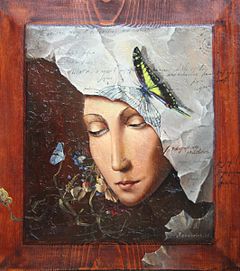
Anastasiya Markovich, Illusion of Reality (2008)
On the other hand, for those of us in the “reality-equals-gritty” school of thought, my Come Dine With Me experience was as real as it gets. It’s possible that my three fellow hosts threw together their divine dinners an hour before each meal (though the standard of the meals strongly suggests otherwise), and probably their houses are always immaculate so they didn’t need to get themselves into a sweat with a last-minute burst of cleaning. Personally, taking the day before my dinner off work, as well as the day itself, spending several days beforehand planning and shopping, neatly slicing off the top of my finger and fingernail when practising my dishes the previous weekend, and to top it all off, having to abandon my dearly-beloved usual weekday uniform of jeans and Crocs in favour of a SKIRT (slyly hoping that its bright pink colour would distract my guests from any deficiencies in my hostessing skills) was more than enough reality for me, thank you very much.
So both extremes of the scale were covered – from wandered-into-the-wrong-film weirdness to gritty realism. Where does fun fit into the reality continuum?
The four dinners were some of the most fun experiences I have ever had. Going over to people’s houses every evening to be served delicious food, get to know some absolutely lovely, funny, talented people (including the presenter and sound engineer), and have cocktails and wine poured liberally down your throat, with full permission to say exactly what you thought of the whole evening afterwards and give your host marks out of ten into the bargain – what’s not to like? Or as my eight-year-old would say: “Uh, HELLO??!”
So how did I do? Nobody knows – yet. The dinner parties have been broadcast on The Saturday Show with Maria McCann on WLR FM, one per show, over the past three Saturdays. Only one individual score for each dinner has been broadcast, so nobody yet knows their total score. The final dinner and results are broadcast on tomorrow morning’s show, when the winner and recipient of the €1,000 (in vouchers for the foodstore that sponsors the show) will be revealed. Keep your fingers crossed for me! (I’d do it myself, only the one I sliced open hasn’t fully healed yet.)
Until then – keep it real.

 Orla Shanaghy's blog - Wait til I tell you