A good dose of reality
Reality is relative. I have recently learned this as a contestant on my local radio station’s take on the current Come Dine With Me craze.
In one sense, my encounter with the reality genre has been one of the most unrealistic experiences I have ever had. Under what real-world circumstances would you encounter the following downright weird scenario: you are required to prepare, serve and host a three-course dinner plus entertainment to three relative strangers, all entirely unassisted, while everything you say is recorded for broadcast on radio?
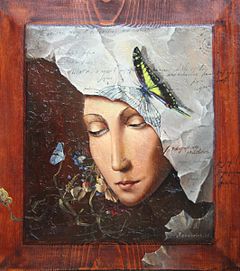
Anastasiya Markovich, Illusion of Reality (2008)
On the other hand, for those of us in the “reality-equals-gritty” school of thought, my Come Dine With Me experience was as real as it gets. It’s possible that my three fellow hosts threw together their divine dinners an hour before each meal (though the standard of the meals strongly suggests otherwise), and probably their houses are always immaculate so they didn’t need to get themselves into a sweat with a last-minute burst of cleaning. Personally, taking the day before my dinner off work, as well as the day itself, spending several days beforehand planning and shopping, neatly slicing off the top of my finger and fingernail when practising my dishes the previous weekend, and to top it all off, having to abandon my dearly-beloved usual weekday uniform of jeans and Crocs in favour of a SKIRT (slyly hoping that its bright pink colour would distract my guests from any deficiencies in my hostessing skills) was more than enough reality for me, thank you very much.
So both extremes of the scale were covered – from wandered-into-the-wrong-film weirdness to gritty realism. Where does fun fit into the reality continuum?
The four dinners were some of the most fun experiences I have ever had. Going over to people’s houses every evening to be served delicious food, get to know some absolutely lovely, funny, talented people (including the presenter and sound engineer), and have cocktails and wine poured liberally down your throat, with full permission to say exactly what you thought of the whole evening afterwards and give your host marks out of ten into the bargain – what’s not to like? Or as my eight-year-old would say: “Uh, HELLO??!”
So how did I do? Nobody knows – yet. The dinner parties have been broadcast on The Saturday Show with Maria McCann on WLR FM, one per show, over the past three Saturdays. Only one individual score for each dinner has been broadcast, so nobody yet knows their total score. The final dinner and results are broadcast on tomorrow morning’s show, when the winner and recipient of the €1,000 (in vouchers for the foodstore that sponsors the show) will be revealed. Keep your fingers crossed for me! (I’d do it myself, only the one I sliced open hasn’t fully healed yet.)
Until then – keep it real.
Thanks, compliments and other awkward things
Everyone likes to be thanked. So much so, that we tend to get a bit sniffy if someone forgets to thank us for something. Children are constantly reminded to say “Thank you”. So why is thanking often such a thankless task?
The after-dinner speeches at weddings – the main participants’ only chance to formally express their gratitude to family and friends – are dreaded by many of the guests, some of whom pass the time by placing bets on their duration. The tearful thank-yous of award recipients on Oscar night are mocked and satirised. Thank-you cards are the Cinderella of the greeting card world, much bought (good intentions and all that) but little used, often lying forgotten at the backs of drawers.
Personally, I am a thankophile. I get a warm fuzzy glow from thanks of all kinds – whether I am the intended recipient or not. I devour the Acknowledgments sections of books. (Why? Do I secretly hope to find myself in them?) For me, the credits at the ends of films are part of the entertainment. (The cleaners in my local cinema hate me – I stay until the screen goes blank and the house lights come on, while they pointedly sweep up the popcorn from beneath the seats on either side of me.)
Compliments – now they are a different matter. I blame genetics. Being Irish, and a woman at that, I am simply not in the right gene pool to be comfortable accepting compliments. As anyone who has met any Irish woman knows, compliment her and you will receive a self-deprecating eye-roll followed by a rattled-off summary of where she bought it (invariably the cheapest, nastiest bargain-basement place in town), how much she paid for it (next to nothing), and the ways in which it successfully hides her hideous figure (it’s basically a potato sack with buttons so it covers everything).
What is the effect of this tirade on the hapless complimenter? As Gil Gonzalez says, rebuffing a compliment is “the equivalent of giving a gift to someone and having them go on about how you shouldn’t have”. The complimenter feels rebuffed, of course – after all, he has basically been told that he is wrong. He is unlikely to compliment the recipient again. Worst of all, he may feel prompted make a re-assessment and conclude that actually, yes, you do look hideous.
Having recently become sensitised to this bad habit among Mná na hÉireann, I have turned over a new leaf. Now, when a compliment comes my way, I suppress the wave of purchasing information welling up inside me. Instead, I pin a smile to my face and say “Thank you”, even if it is through gritted teeth.
People with religious beliefs are likely to be more familiar with the therapeutic properties of thanking, in the form of prayer. As a child, I bothered God on a nightly basis with a list of thanks and acknowledgments that would have put any Oscar recipient to shame. Now that any notion of God and I have permanently parted ways, I have discovered the concept of “gratitudes”. Gratitudes are like prayer in that (ideally) you say them (usually to yourself) first thing in the morning or last thing at night, or both.
To whom is my gratitude addressed, you might ask? For me personally, gratitudes are a way of enabling myself to feel gratitude for the good things in my life; they are not directed at specific people. Any specific thanking that needs to be done, I like to do in person.
A related issue is the use of terms such as “No problem” and “No worries” to respond to thanks. Now, these statements are appropriate to some degree – at least they are an acknowledgment that thanks have been given. However, as I recently read somewhere, these statements are still off the mark, as their underlying assumption is that there might have been a problem or a worry to begin with. They introduce a negative slant to what should have been a completely positive interaction: thanks given, thanks received. A much happier response to thanks is a simple “You’re welcome” or its more refined cousin, “It’s a pleasure”.
Back to thanks. I recently spent some days in bed due to illness. With the help of family and friends (including my very good friend, the internet), life in the Curmumgeon household continued pretty much as normal while I recovered. All attempts at thanks by me were rebuffed with responses along the lines of “Sure what kind of parent / friend would I be if I didn’t help out?” Which is a very canny way of putting an end to my thanking overtures.
I might have to don a fluffy pink dress, go on TV and burst into tears to show them I really mean it.
Overheard
I overheard the following exchange in the doctor’s surgery the other day:
Older man to receptionist: “Are you the girl that works in Specsavers?”
Receptionist: “No, not me.”
Man: “Are you sure, I could have sworn I saw you behind the counter in Specsavers.”
Receptionist: “No, definitely not me, I work … er … here.”
Seems going to Specsavers doesn’t always have the desired effect…
Mother, reassigned
Following the example of our political leaders, I am updating my job title from “Mother of Three” to the following, with immediate effect: Minister for Transport, Health, Education, Defence, Justice, Food, Finance, Equality, Sports & Tourism and Mental Health.
Lines Penned On the Occasion of the Epiphany
I wrote this a few Christmases ago. A bit of light-heartedness seems especially appropriate now as 2010 draws to a close. Remember, it’s for a giggle, people – no disrepect intended to anyone of any religion! Merry Christmas everyone!
Lines Penned On the Occasion of the Epiphany
In olden times – nay, yesteryear,
Or perhaps it was days of yore,
Three Irish men sat down to plan
A trip to a far-flung shore.
They’d heard Our Lord had just been born
And they just had to see Him first-hand
They settled it over a couple of pints
They would head for the Holy Land.
Frankie Malone was the brains of the group,
He would sort all the travel and visas,
While PJ O’Brien would make sure to sort out
Some gifts for the baby Jesus.
PJ and Frank knew that Willy Magee
Was a few bricks short of a load
So to give him a job, they put him in charge
Of refreshments and snacks for the road.
They were finally ready, the boys set off.
The road was a hard one at first.
But their spirits were high and Willy had packed
Five slabs of Dutch Gold for the thirst.
In Damascus they met up with three fellas in turbans
Who claimed to be led by a star
Our heroes just shrugged – they were tolerant types –
And they asked them along for a jar.
Frankie and Co. felt guilty next morning
When their friends couldn’t move from their beds
But with no time to waste, they bid them goodbye
And left them there nursing their heads.
As they got nearer Bethlehem, matters improved
In terms of their method of travel
The locals stood back in amazement and gazed
At the three Irish lads on a camel.
In a field outside Bethlehem they had a wee session,
The end of the journey was near.
“And just as well too,” hiccuped Willy Magee,
“’Cos that’s nearly the end of the beer.”
“One last thing,” cautioned Frank, as he downed his last drop,
“We’ve a problem: our names are too silly.
They’ll laugh at us in Bethlehem if we say that our names
Are PJ, Frank, and Willy!”
“What were those lads called who we met in the bar
And left sound asleep in Damascus?
Oh yeah – Casper, Melchior and Balthazar,
We’ll just say those if they ask us.”
They set off and were just at the stable door
When O’Brien did let out a groan.
“The gifts for the babby – I got them, but lads –
They’re in the boot of me car back at home.”
“Here – divide up this stuff I bought in that bazaar,”
Said Frank, having thought for a minute.
“It was meant for the missus, but she’ll be none the wiser,
Sure I haven’t a clue what is in it.”
So they knocked on the door, and were welcomed inside,
They rejoiced at the Virgin Birth.
Then a shepherd regarded the gifts they had brought
And scornfully asked, “What on earth?”
“Twenty shekels that cost me!” said Frank, incensed.
“Mmm – errr…” said PJ, far from sober.
Then Willy produced his last can of Dutch Gold
And solemnly handed it over.
People heard far and wide of the three foreign men
And their strange tongue (some believed it was Greek)
And the gift they had brought for to worship Our Lord
(Even if it was somewhat – unique).
Only three weary Persians, not long back from a journey,
Declared there was really no mystery.
But no-one believed them how three Irish blokes
Stole their place in the annals of history.
End
© Curmumgeon 2010
A Tribute to Mick Lally, 1945 – 2010
The facade of the Forum theatre in Waterford looks down on a sloping plaza that is itself surrounded by the small terraced houses that mark this historic part of the city. Here and there between the houses run narrow streets with centuries-old names, some leading down towards the Quay, others up the town to Ballybricken and beyond. It was down one of these streets, as I stood outside the theatre after a performance of The Castlecomer Jukebox in 2004, that I watched a solitary, tall, hunched figure lope away, hands in pockets, probably off for a quiet post-performance pint in one of O’Connell Street’s pubs. That figure was Mick Lally.
I never had the good fortune to meet Mick Lally in person, but I cannot shake the feeling that I have known him all my life. To my brothers and me, like many Irish children in the 1980s, the Glenroe theme tune signalled the dreaded Sunday-night bedtime (as much as it probably signalled to our parents the time when they could finally sit down and watch some TV in peace). Even when we were too young to actually watch Glenroe, we and our schoolfriends knew all the characters and especially Miley, the beleaguered everyman with the bewitching voice and a brilliant catchphrase that we repeated with delight at every opportunity.
Being finally allowed to stay up beyond 8 pm on Sundays to watch Glenroe was a real rite of passage. As well as being a staple in that show, to those of us growing up in Ireland in the 80s, Mick Lally always seemed to be around, be it on TV or radio. He even managed to turn a TV ad for cheese into a memorable experience, his mellifluous tones combining deliciously with the thrumming of a bodhran’s beat.
The years passed, I moved to Dublin, and even though as a student I no longer had access to a TV, Mick remained a constant. My Austrian friend Sabine visited Dublin and to give her a taste of Irish theatre, my boyfriend and I took her to see A Skull in Connemara, with Mick in the lead role. We had great seats looking down on the stage. I remember being overawed by Mick’s looming, menacing presence in that role. I was also delighted that we had an actor of such calibre in this country that enabled me to show off our culture to a visitor so successfully. In the pub afterwards, Sabine’s English was tested to the limits as she tried to put into words the impression his performance had made on her.
These days, my husband and I, now with three children, rarely get to listen to an entire radio show, so it was a special treat on a recent drive to Dublin to turn on the radio and hear Mick’s voice. He and another wonderfully familiar actor, his Glenroe co-star Mary McEvoy, were being interviewed by Miriam O’Callaghan. As the children, miraculously, slept in the back, it was a delight to hear him describe his life and career with endearingly self-deprecating good humour, and just as much a delight to simply sit and listen to his voice. To hear his gorgeous spoken Irish was another pleasure.
Perhaps because that interview is so recent, the news this morning comes as a particularly sad shock. It strikes me that as we advance into our mid-thirties, us Glenroe children have now reached the age where the death of a well-known person can feel like the death of something in us. Mick Lally was part of the background of our lives, whether we paid his presence there much heed or not. Now that he is gone, I personally, for the first time, feel the loss of a person I never actually knew.
Although, thanks to that radio interview, it is not long since I heard him speak, my last, and lasting, visual impression of Mick Lally is that evening in Waterford in 2004, when I watched him walk away down a dark street after another brilliant performance, alone, seeking no accolades, a quiet master.
(c) Curmumgeon 2010
Clothing Remarks
Anna Carey at The Anti-Room got me thinking about us workers-from-home and our often strained relationship with clothing.
I’m in the “slippery slope” school of thought on this one. In other words, what starts off as simply not removing your slippers for work can easily become not removing your pyjamas. From there, it’s a slippery slide to just staying in bed with the laptop. And as the saying goes, she who works in pyjamas, thinks in pyjamas.
OK I just made that one up.
In my experience, what I am wearing for work directly affects my frame of mind and the quality of my output. For example, imagine what wonderful work you could produce in this get-up:
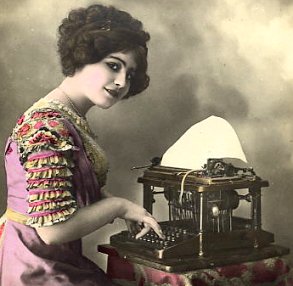
With hair this adorable and a dress this frilly, what does it matter if I type without looking?
Having said that, I do not sit in my home office in power suits and stiletto heels. As long as my apparel can be fairly classified as outerwear, is clean and sometimes even ironed, and is fit for opening the door in, I consider myself properly kitted out for a good day’s work at the PC.
Lately, however, standards are starting to slip. Advancing age and the mellowing that goes with it means I can justify an increasing degree of slovenliness. Although I have noticed that my slovenliness varies in accordance with the people I expect to encounter:
Postman – pyjamas: not appropriate; dressing-gown: yes, at a stretch; hair brushed: no need.
Childminder – all bets off, even teeth unbrushed is OK.
Female friends – different league; fashionable gear and make-up required to maintain competitive viability amongst peer group.
Family members – a degree of pride is involved here so: pyjamas – no way; dressing-gown – only with good reason, such as having recently given birth or illness; bare feet / slippers – better not, as although seemingly minor, these can be interpreted as little “telltale signs” (of anything from a dip in work levels to full-blown depression).
Children – irrelevant – they are utterly indifferent to what I am wearing as long as I maintain the expected flow of food, drink, cuddles, transport, entertainment and soothing-to-sleep.
I do have one sacred cow when it comes to clothing, though: pyjamas should never, ever be worn to the supermarket, to the bank, at the school gates, or anywhere else in public. Being seen in public in your jammies is only a small step away from being seen out in the nip, and that is the stuff of a well-known universal nightmare, with very good reason.

No, no. Not even wrong.
No matter how curmudgeonly I become, I hereby declare that I will never sink that low. Amen.
Daughters and Dinnertimes
Dot is at home sick today and in time-honoured home-sick-from-school fashion, she is embedded in the sofa, wrapped in her dressing gown, watching kids’ TV on RTE. To be fair, she does have the pale complexion, watery eyes and listless demeanour that justify the day off.

Gabriel Metsu, The Sick Child, 1663 - 1664
As a worker-from-home, there was a time when a sick child spelled disaster work-wise. Rather inconsiderately, children never give notice about being sick – they simply present themselves on the morning in question, glassy-eyed and sweating. So there is rarely time to re-negotiate deadlines with clients. Previously, to make up work time lost to minding a sick child, I had to work in the evening, usually in the form of a multiple-hour late-night session that left me feeling like I needed a day off, too.
Now that Dot is an independent and competent seven-year-old, she is happy to mooch about the house, help herself to drinks, watch TV, read and rest, while I can work pretty much undisturbed apart from the occasional request for toast (independent or no, a recent close encounter between a knife and the toaster means she has not yet got her Toaster Pass).
In other news, Carmel Somers’ new book, Eat Good Things Every Day, is having positive effects in the Curmumgeon household. Carmel runs the highly-regarded Good Things Cafe in Durrus, West Cork. In this book, she applies her professional chef’s practicality and organisational skills to the domestic sphere. I have always been a fan of leftovers and since having children, I have been allergic to cooking from scratch on a daily basis. Carmel shows how to best create dishes that yield plenty of leftovers and how to use those leftovers to create further meals (real, delicious ones, not simply reheated) on subsequent days. Besides the ample recipe section (many of which feature on the menu in her cafe, apparently, which makes me really want to visit), there are very useful sections on stocking your store cupboard, the “basics” (including a blindingly simple method for cooking a few days’ worth of deliciously-flavoured rice), and some common sense on cooking for children (in a word: don’t!).
The result in this house has been some new dishes that met with great approval (egg-fried rice (made with the rice mentioned above) with roast chicken leftovers and spinach (ready in five minutes) and roast shoulder of pork with divine gravy being particular hits) and a smoother-running kitchen routine that has Curmumgeon a little less frazzled at dinnertimes. Now that’s definitely a good thing.
On snow, slush and socks
The year got off to a good start for curmudgeons in this part of the world, with snow and sub-zero temperatures keeping people housebound for weeks after Christmas. Today, despite a slight thaw, the omnipresent slush is ensuring that we still have plenty to grumble about.
Now for the Top Five bizarre sights of Ireland’s recent bad weather (in no particular order):
1. People shuffling along ice-bound footpaths wearing thick socks over their shoes. This shows a suspicious level of practicality and good sense by the Irish public. Sure enough, it emerged that this “snow tip” was communicated to Irish national radio by a German (who, along with the rest of his compatriots, is probably tickled pink by the chaos caused in this country by a few inches of snow).
2. People out on the footpaths at all. Ireland is a nation of car-lovers, which, coupled with disastrous public transport, makes driving something of a national pastime. Now that the ice on the roads has forced many to re-think the two-minute drive to the newsagent’s, we are seeing more of that rare breed: pedestrians!
3. Snow. The last time that Irish children were able to make snowmen and have proper snowball fights was a generation ago.
4. Dali-esque snow figures. Today’s thaw has seen snowmen and -women shed various limbs, or heads. Some of the less robust ones have imploded altogether, creating disturbing post-apocalyptic images in front gardens and public parks.
5. Drivers, obviously rendered giddy by the slight rise in temperatures, reverting to their normal driving habits – overtaking, speeding, not watching the road – despite repeated warnings in the media that slush is more hazardous than snow.
Angel therapy
Hot, Dot, Bot and I were out this evening for the first time in ages. Frugality is very much in vogue here at the moment, so dinner in our local Irish-Italian eatery had the air of a novelty. Hot and I had braced ourselves for an hour and a half of snatched bites of dinner in between crowd control measures, ranging from verbal warnings to physical restraint, depending on the amount of Coke Dot managed to sneak past us and into herself.
Dot caught us completely off guard by being a total angel. Dinner was ordered in a Shirley Temple voice with manners to match. Please and thank you were said. Requests for drinking straws, small spoons, colouring books and extra cheese were made at our table, sitting down. Even Dot’s recession-coping mechanisms were successfully tested – the news that the restaurant no longer does Babychinos (now there was an example of the Celtic Tiger gone completely doolally) was received with stoicism.
Bot tried to balance things out by pulling a button off my new boyfriend cardigan, but I barely noticed, so giddy was I with delight at Dot’s model behaviour.
Now I am spending the rest of the evening fighting off evil musings about what it is she wants. Bad Mommy!

 Orla Shanaghy's blog - Wait til I tell you