Serious chocolate tiffin
I found this recipe on the inside of a wrapper of Green & Black’s milk chocolate (currently my favourite chocolate, in case anyone feels like sending me some…) and propped it optimistically on the book stand on my kitchen windowsill, where it languished for some time:

The recipe
To be honest, the recipe kind of intimidated me. It’s obvious that this is some serious, knock-your-socks-off confectionery. It uses ginger biscuits and pistachios, for goodness’ sake!
Finally, yesterday, the planets aligned. It was time for some serious tiffin-making.
Assembling and preparing the ingredients took some time. As usual when I bake, off I went with the young one to my local independent supermarket for the supplies. Needless to say, the recipe calls for Green & Black’s chocolate, but I had some Lindt to use up:

The cocoa was Green & Black’s, and the golden syrup – well, in this part of the world, the only show in town is Lyle’s:
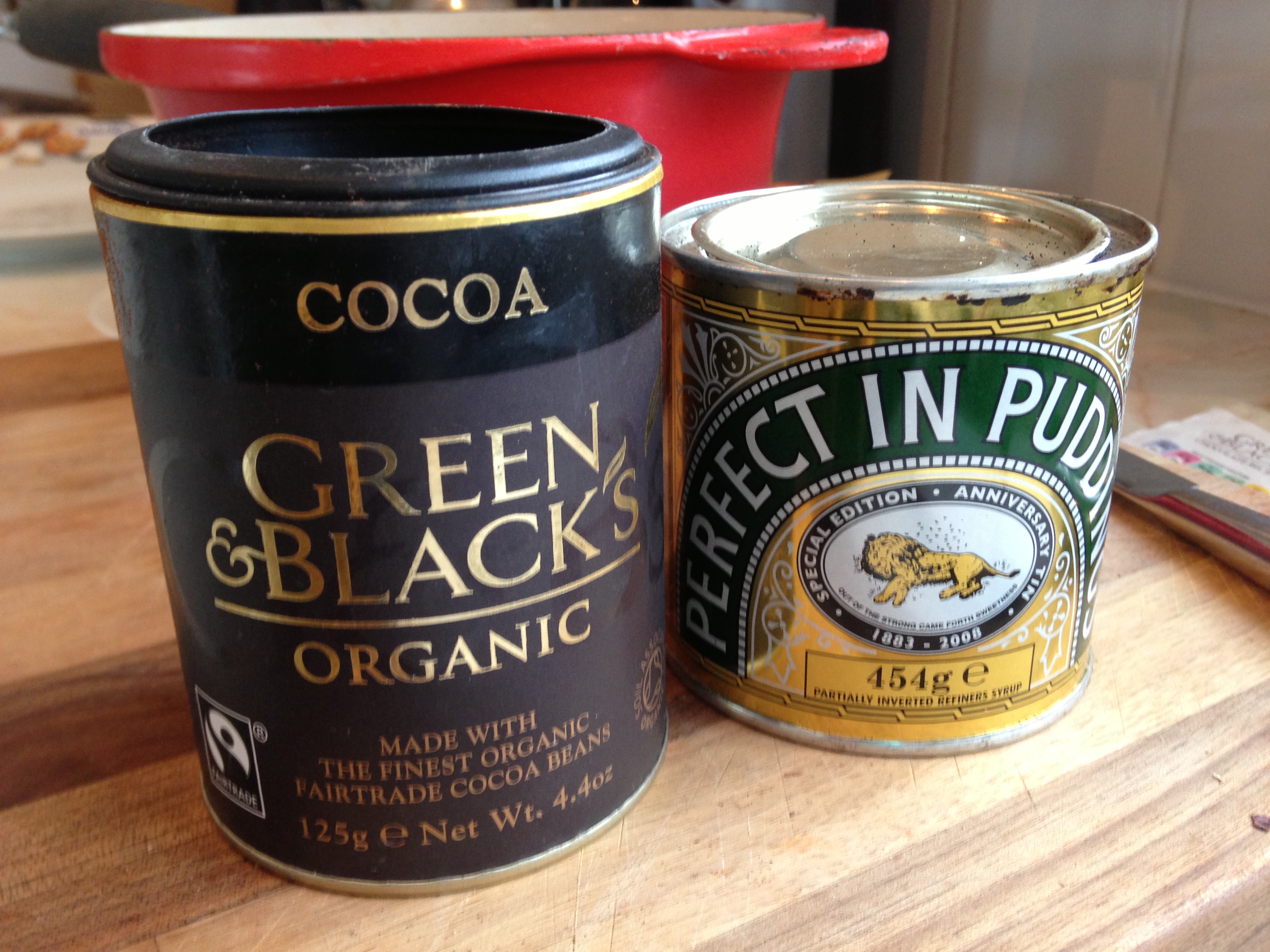
I have a feeling that tins of Lyle’s golden syrup would be left rattling down the streets after a nuclear apocalypse. Golden syrup is based on inverted sugar syrup, a substance I would rather not know any more about. And once you open the tin, some syrup inevitably drips over the side, despite the little gully around the edge, and you have a sticky tin for ever more:

Lyle’s golden syrup gully
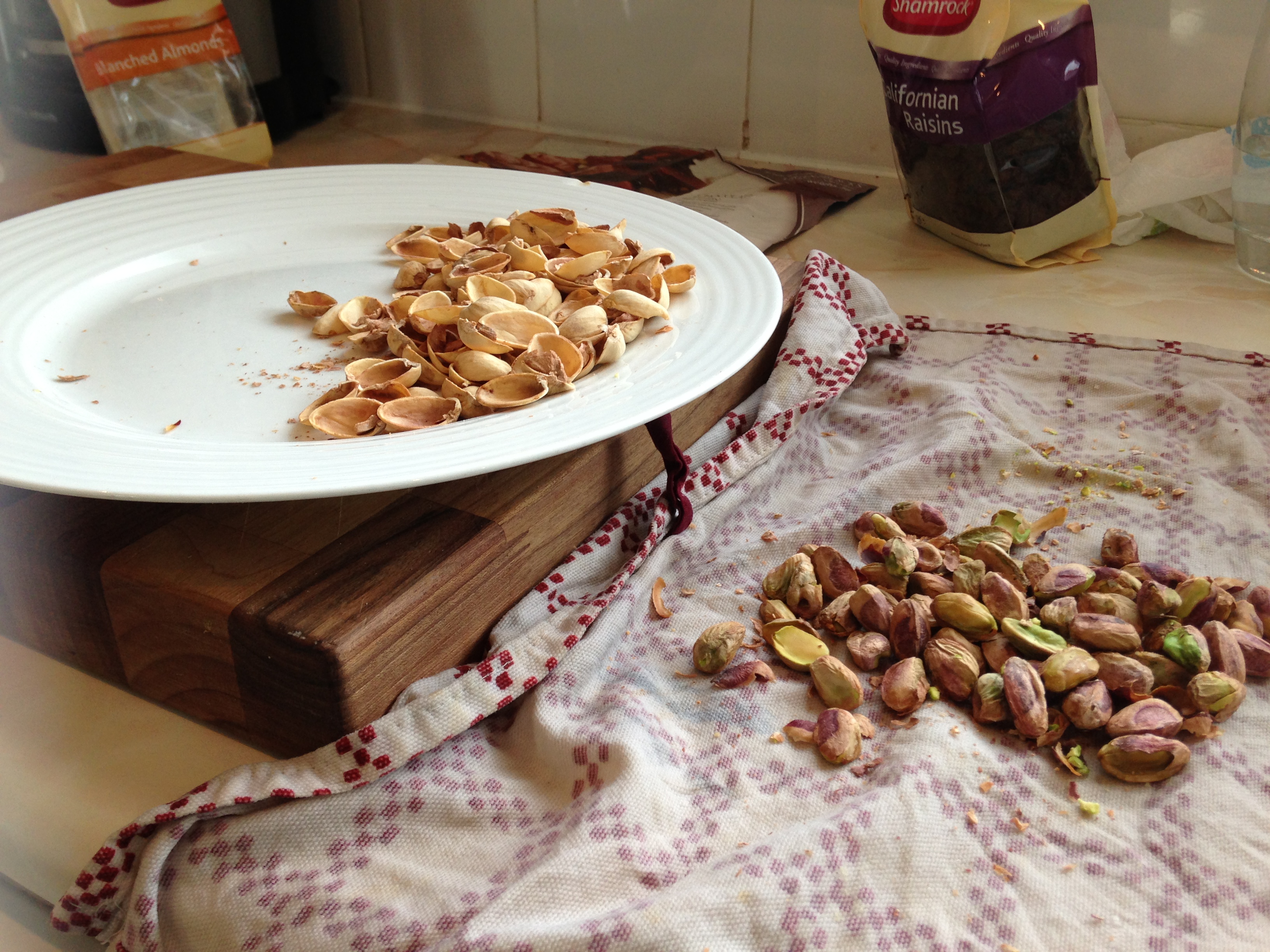
Next up are the nuts. This recipe calls for blanched whole almonds and pistachios. I couldn’t get pistachios pre-blanched, so I had to do it myself. Some of those babies are stubborn to prise open – cue a little swearing …
Another challenge at the preparation stage: how to crush the ginger biscuits? Being a lazy sort, I decided to get down the food processor from its position on high…

… and whizz the biscuits. This produced an inconsistent mixture of biscuit dust and almost-whole pieces:
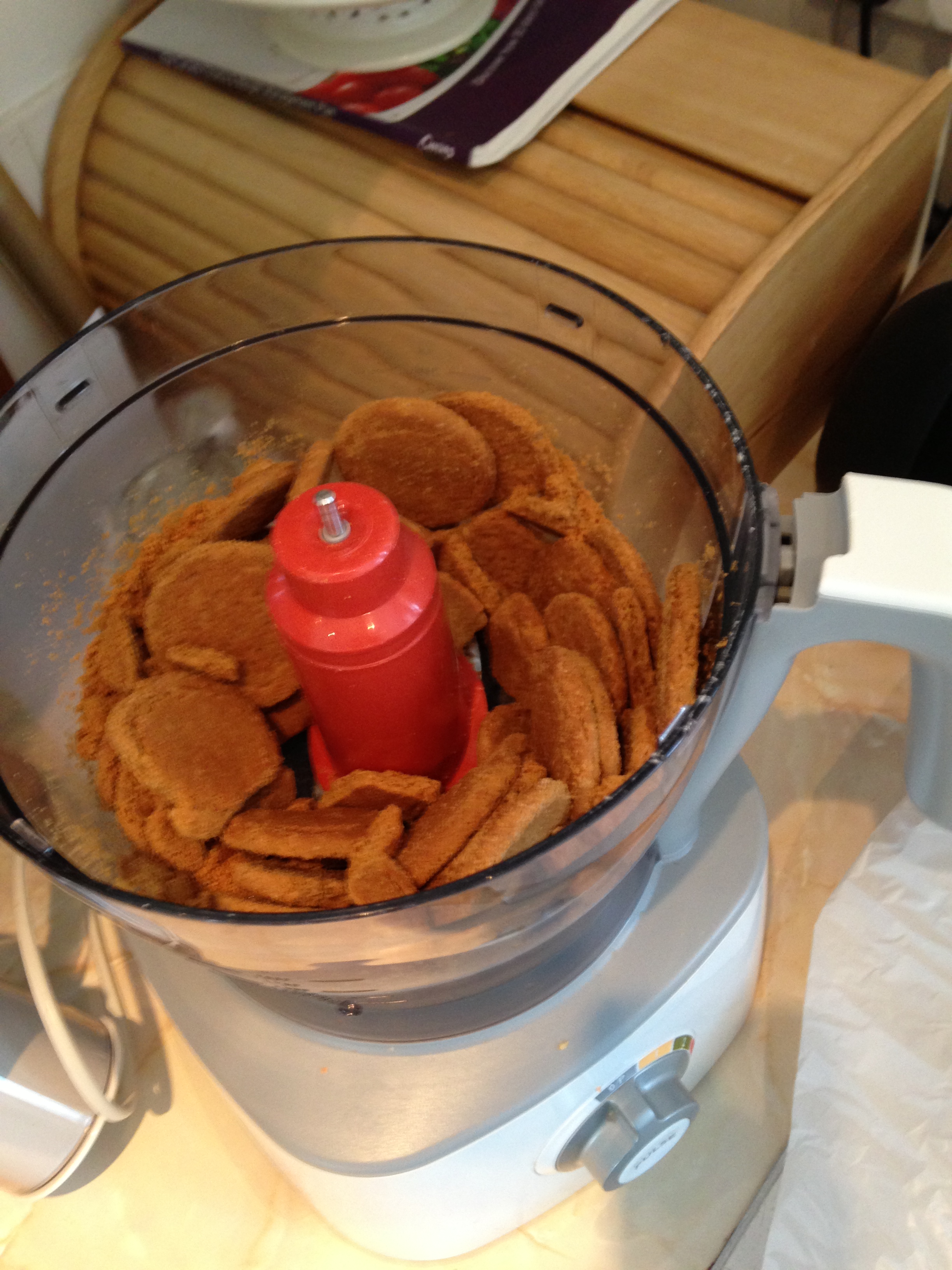
Whizzed ginger biscuits … not good
So I overcame my laziness and out came the plastic bag and rolling pin. The results were more even:

The more successful plastic-bag-and-rolling-pin method
If you do this, remember to be restrained in your battering of the biscuits, or you will end up with more dust. (Oh, and hold the opening of the bag closed in one hand, as semi-crushed biscuits all over the kitchen floor rarely leads to happiness.)
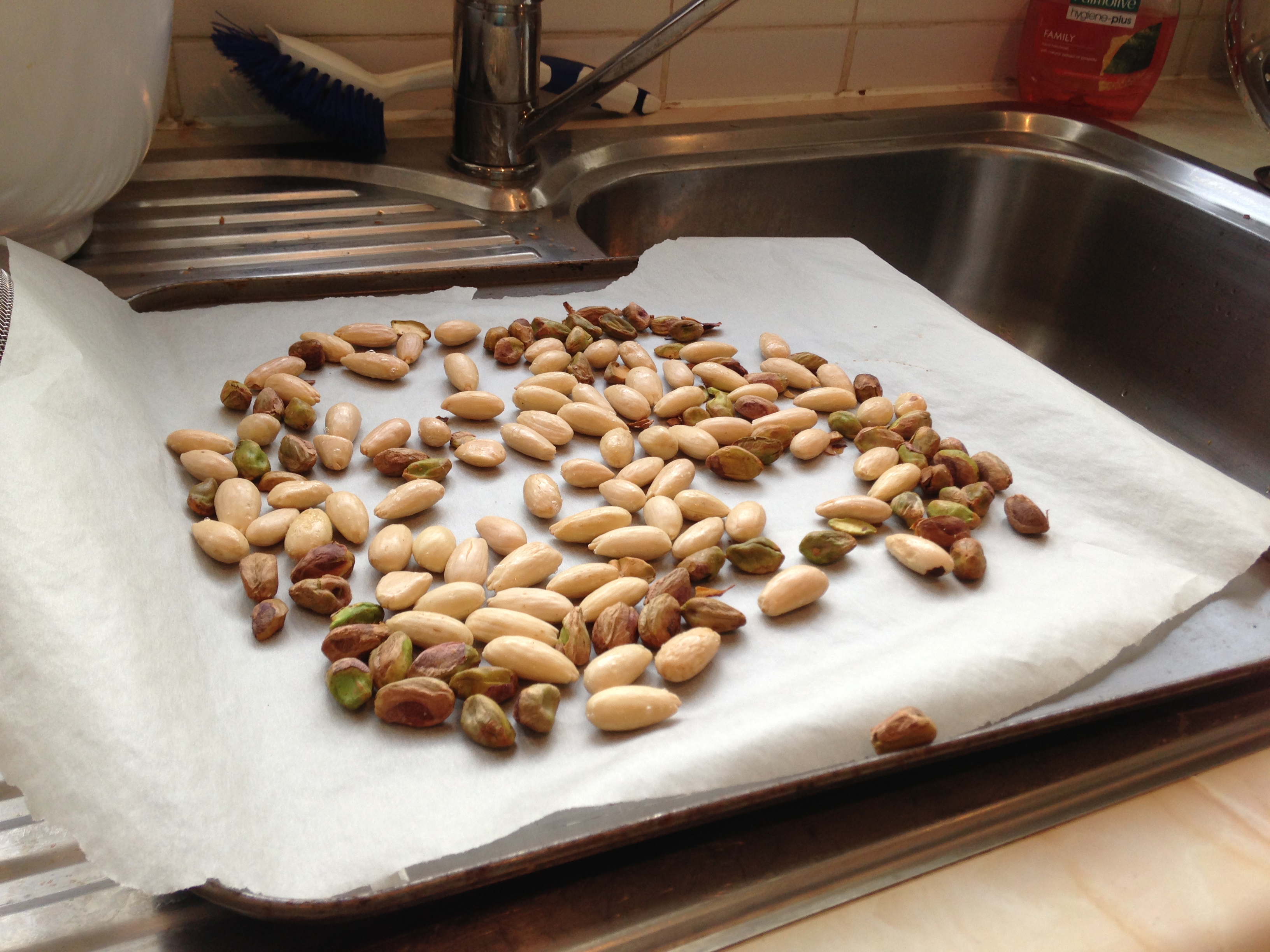
Next up was the roasting of the nuts, which takes only five minutes. But what a five minutes! The aroma of the pistachios as the heat of the oven draws out their oils is beyond words, so a picture will have to do:
The next step called for a little “necessity is the mother of invention”. I didn’t know what to do about the skins on the pistachios, and I temporarily forgot about the existence of the internet. So first I swirled them around in a colander…
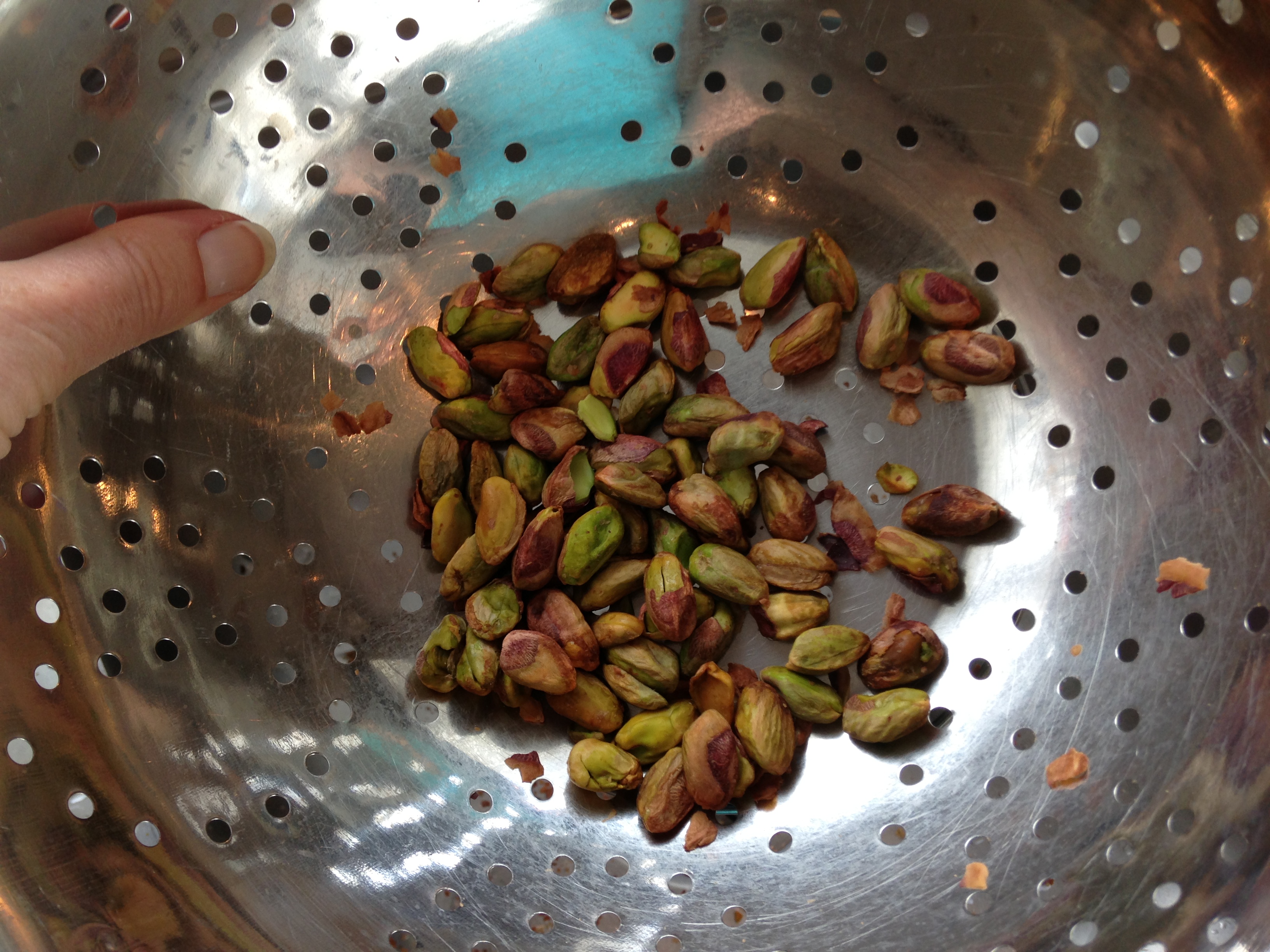
… but not many bits of skin came off. I then wrapped them in a damp tea-towel, rolled them up and roughed them around a bit:

This process removed most of the skins.
Now for some actual mixing of ingredients. The crushed biscuits, sultanas, cocoa and roasted nuts come together first:

Then in go the melted butter and apocalypse syrup – I mean, golden syrup:

As you can see in the picture, an ordinary kitchen knife does a good job of mixing sticky, unctuous mixtures like this.
That’s your mixture done. Grab a nearby small child (ideally one of your own) and get them to help you to scrape the mixture into the baking tin (my last food post contains a quick-and-dirty method of lining a baking tin). The child can lick the bowl and utensils clean as a reward:

Smooth off the surface of the tiffin with the back of a metal spoon:
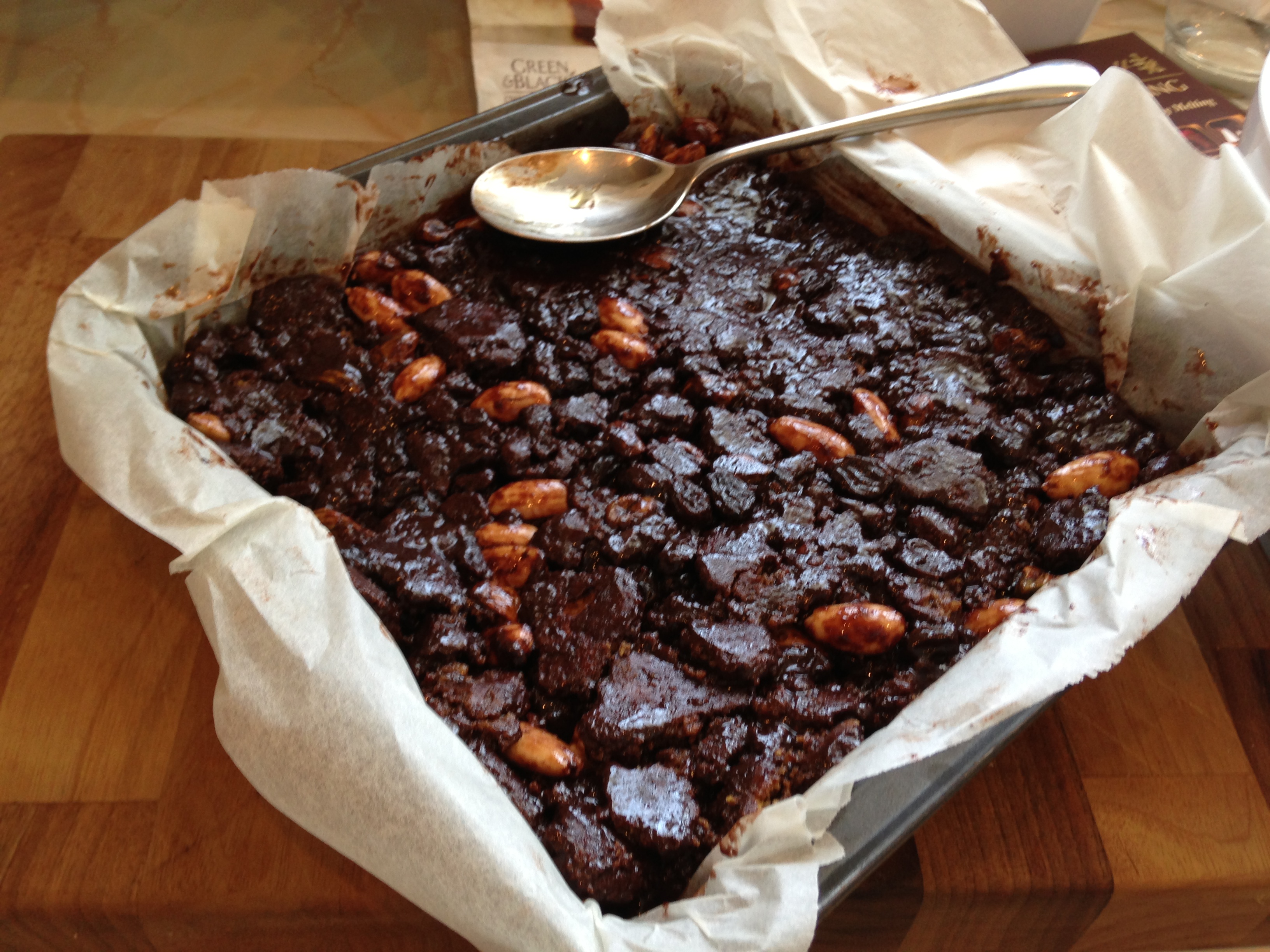
Now for the chocolate. Some fancy folks melt their chocolate in the microwave. Call me old-fashioned, but I do it on the hob, in a perspex bowl over a saucepan of gently simmering water.
Now pour that liquid joy over the biscuit mixture. The Green & Black’s recipe instructs us to do this in two stages, and who are we to disagree?
 Clear a space in your fridge and in it goes for half an hour (the recipe says five to 10 minutes, which I don’t trust. Not that I think I know better than the Green & Black’s recipe designers – but they can’t be right all the time, can they?).
When it comes out, it looks like this:

At this point, your family or house-mates will be starting to circle, so cut it up quickly into the tiniest squares you can manage. This is how my finished product looked:

Now take a deep breath before biting in. This is powerful stuff, and only small pieces are needed to produce a truly heady sensation.
Peanut butter and white chocolate blondies: a treatment for chicken pox
After almost six years of blogging, I’ve decided to add a new topic: food. I seem to spend quite a bit of time cooking these days (four children definitely has something to do with it), and I certainly spend lots of time eating, so I have lots to share. Here goes…
Peanut butter and white chocolate: a treatment for chicken pox
No, not to rub onto the sores… To eat, in the form of peanut butter and white chocolate blondies.
Poor Daughter 2 was home with chicken pox all last week. Since baking is a known treatment for all minor childhood illnesses, I thought I’d try to take her mind off things with this incredibly more-ish recipe from Rachel Allen:

Having peeled Daughter 2 away from her zillionth episode of Peppa Pig (hey, it’s summer in Ireland, which means it was too wet and cold to go outside), we got started by creaming the softened butter and peanut butter:

Creaming the peanut butter and butter
If you forget to take the butter out of the fridge in advance to soften, cut it roughly into cubes, put it in the microwave on the Defrost setting for 30 seconds at a time and check after each interval until it has softened.
We used fancy organic peanut butter. I’m not the most confident baker so I tend to overcompensate by using good ingredients and hoping they will balance out any deficiencies in the cooking. Also, I live near Ardkeen Quality Food Store, which besides being an Irish small business success story, gives me all too easy access to high quality foods that can be hard to find elsewhere. (No, they didn’t pay me to write that!)
Back to peanut butter… I’ve used cheap-n-cheerful brands of peanut butter before and the results are also delicious.
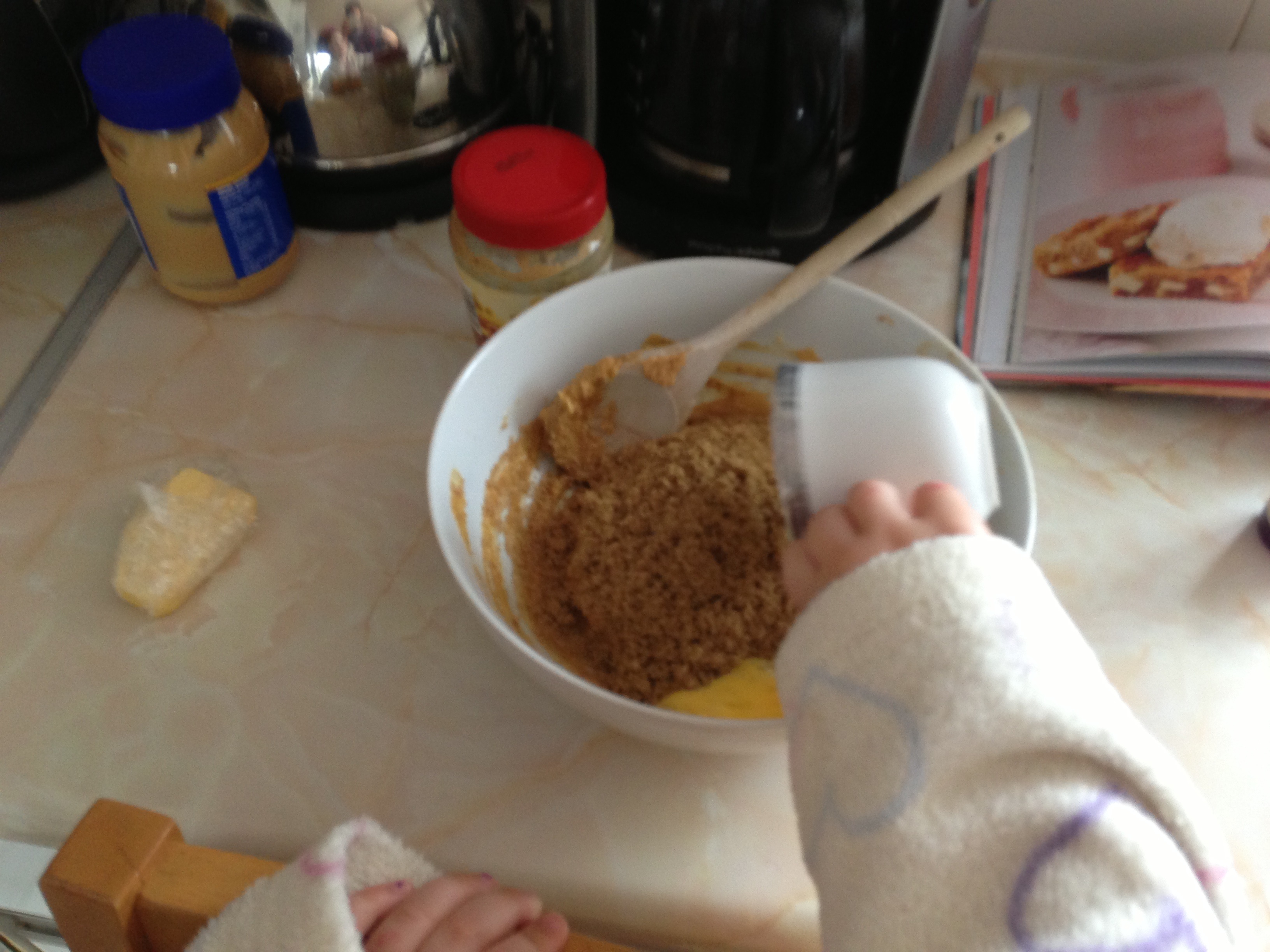
Adding the beaten egg and brown sugar
At last! I’ve been itching to finish the old bottle of vanilla essence for ages, so I can open this one – organic Madagascar bourbon vanilla extract:

Adding the vanilla
The sick child doesn’t get to just watch – she got to work at this point (yes, the pox-y arms in the photo are hers):

Adding the flour and baking powder
It would be quicker to use a food processor for the mixing, but the good old-fashioned wooden spoon is better when cooking with children. It means they can get involved in mixing the ingredients and feel more ownership of the finished product. (Nice bit of corporate-speak there!)
The next bit of magic is the white chocolate:
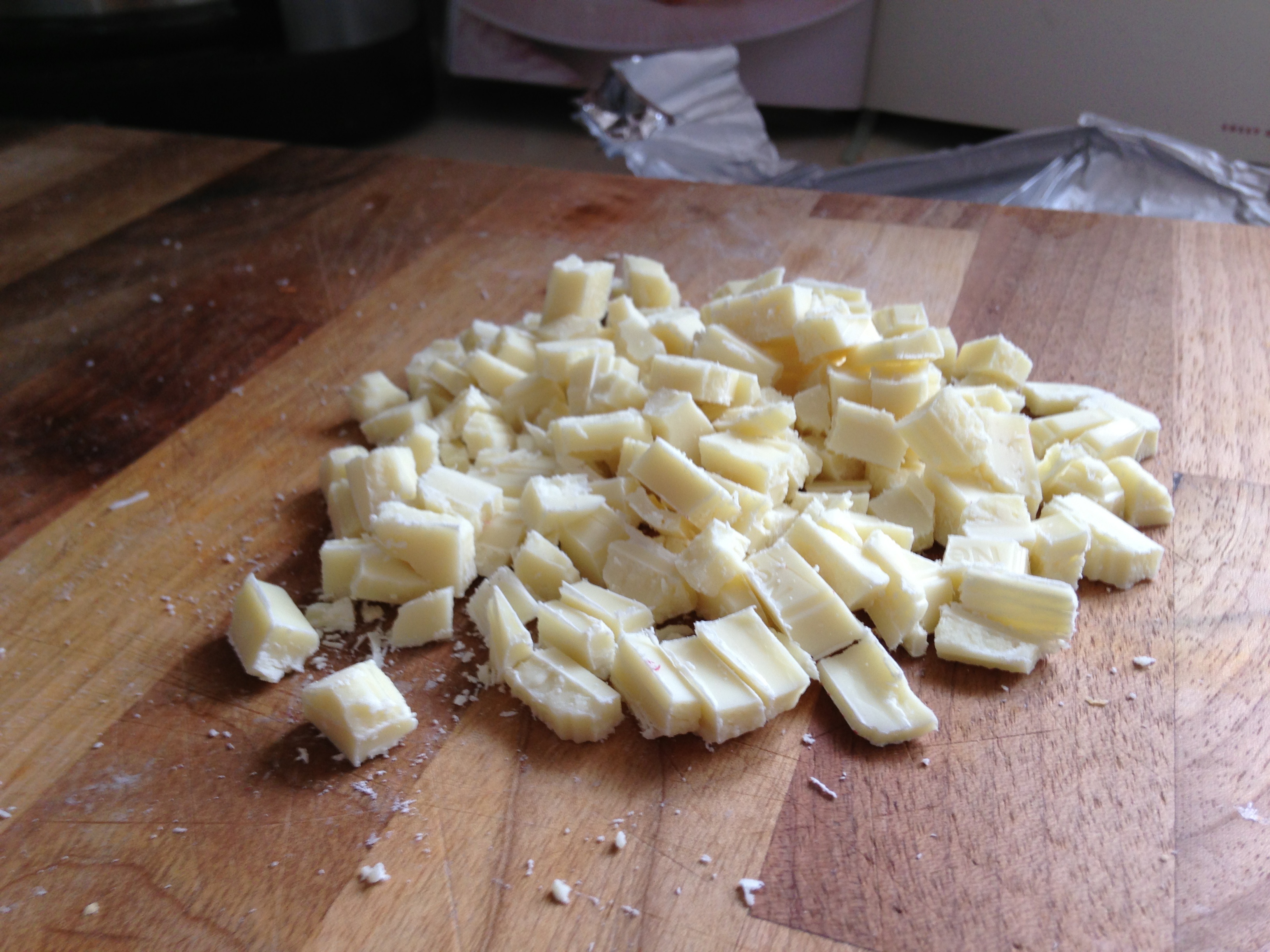
The chopped white chocolate
 We used Swiss patisserie chocolate (told you we were being fancy). White chocolate buttons or drops would do fine as well, though you do get more substantial gooey splodges of melted chocolate in the finished blondies if you chop up a slab of white chocolate into pieces like this.
Rachel instructs us to butter and line the baking tin. She has three children so she should know better. Any volunteers for cutting out the correctly sized pieces of paper, then buttering and lining the tin while a be-poxed four-year-old fidgets, fusses and possibly even wails with impatience? Didn’t think so. Instead, get the child to tear off a good-sized piece of baking parchment and lay it on top of the tin like this:
 Then just scrape in the blondie mixture:

And smooth out the top:
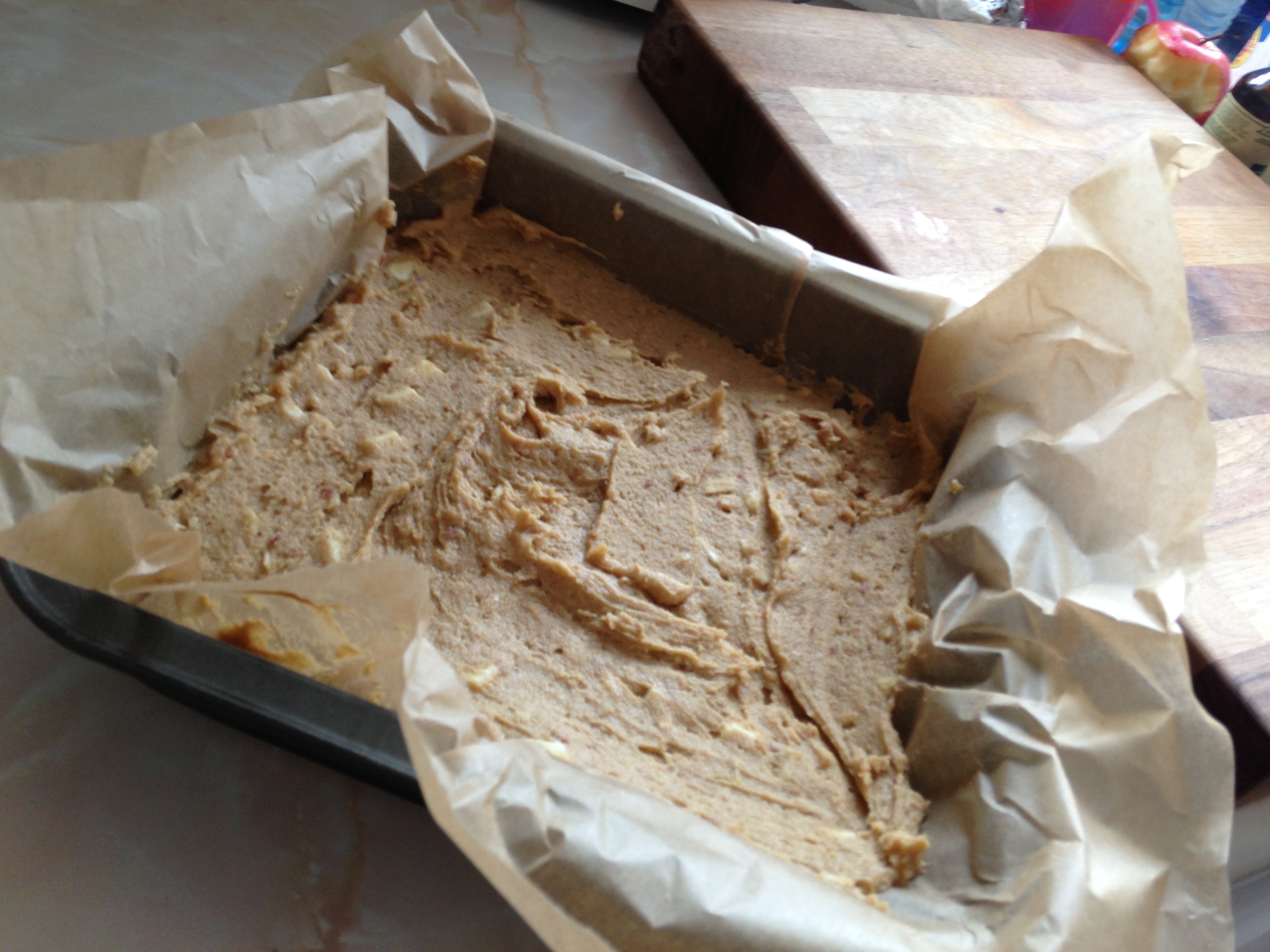
And into the oven it goes.
Lastly, persuade the child that waiting thirty minutes to eat something yummy is a GOOD thing (I leave this part up to you).
Enjoy!
A real gold blend: Thomas Hardy, Jon Lord, Jeremy Irons
I completely love the internet. (I suppose I wouldn’t be much of a blogger if I didn’t.) Just this morning, it presented me with a little piece of joy: Thomas Hardy’s poem Afterwards read by the actor Jeremy Irons, with music and performance by Jon Lord, formerly of Deep Purple, and images by YouTube user AntPDC. The clip is here, and the full text of the poem is here.

Thomas Hardy
The recording is a real gem of blended media. At the risk of indulging in hyperbole, I’m not sure how the piece could be better. Irons’ sonorous, seductive voice, Hardy’s sensuous, nature-steeped word-picture, the deep beauty of the original photography by AntPDC and Lord’s soothing, flowing piano are simply a perfect combination.
Hardy’s poem is also a joy to experience on its own. I’ve always loved the dusky, musky, earthy world of Hardy’s poems. (During Wind and Rain is another lifelong favourite of mine, with its “creeping moss” and “rotten rose”.)
One of the things about Afterwards that tickles my fancy are the little insights it gives us into how the English language has changed, even in the relatively short time since the poem was first published (1917). A lovely example is Hardy’s use of the phrase “at last” in the first line of verse four:
“If, when hearing that I have been stilled at last…”
In Hardy’s day, “at last” was used simply to mean “at the end”. That usage is now all but obsolete and we now use it to mean “after a long wait”, with overtones of irritation and relief. Despite how this line sounds to our 2013 ears, we can safely assume that Hardy was not waiting impatiently for his own death. I love how the line shows the effects of time on language usage, with the resulting unintended humour.
My thanks go to Irish playwright and novelist John Mac Kenna, who alerted me to the recording.

Jon Lord, musician
Meningitis World Day Special: Siobhan’s Story – Ordinary People with Extraordinary Lives series
Today is World Meningitis Day. To mark the day, I’m re-blogging a post by Carmel Harrington in which Carmel interviews Irish paediatrician Dr Siobhan Connor. Essential reading for parents and anyone who looks after small children:
Siobhan’s Story – Ordinary People with Extraordinary lives Series, Meningitis World Day Special.
In memory: Ruth Prawer Jhabvala
 Nick Hornby’s character Rob Fleming in the novel High Fidelity is famous for, among other things, categorising his music collection in autobiographical order. The same thing can happen with writings and books. For example, you always feel a twinge of pain when you see Catcher in the Rye on your bookshelf, because you were reading it when your teenage boyfriend / girlfriend dumped you; you will never throw out that copy of Generation X, because you were reading it when you first left home to go to college; and so on.
I think I had an autobiographical writing-related experience last week. I had a lovely Wednesday evening tucked up in bed with the latest issue of The New Yorker. In the Fiction section was a short story called The Judge’s Will by Ruth Prawer Jhabvala.
It seems odd, but I had never heard of her; that she was a prolific and highly-regarded writer of novels and screenplays as well as short stories, and the recipient of many awards, including two Oscars and the Booker Prize, I learned only afterwards.
The next day, I opened up my Twitter feed and read that Ruth Prawer Jhabvala had died that morning.
![By Cmacauley (Own work) [CC-BY-SA-3.0 (http://creativecommons.org/licenses/by-sa/3.0)], via Wikimedia Commons](https://waittilitellyou.com/wp-content/uploads/2013/04/ruth_jhabvala__wm_phillips_new_delhi_1962-1.jpg)
Ruth Prawer Jhabvala, New Delhi 1962
The fact that the next time I heard about her, Ruth Prawer Jhabvala had died, should make no difference to how I will read her from now on – but it will. Rightly or wrongly, I feel lucky that when I first got to know Ruth Prawer Jhabvala’s work, she was a living author, if only for a few hours.
To honour her memory, The New Yorker has unlocked six of Ruth Prawer Jhabvala’s stories, so they are free for anyone to read. The Judge’s Will is here.
Good Friday, a 400-year-old poet, and a bit of heavy metal
I was reminded today of a poem I had not read in years (thank you, Twitter): Goodfriday, 1613. Riding Westward by John Donne. Today, Good Friday, is the 400th anniversary of the poem’s composition.
Now it’s not too often that 400-year-old poets crop up on Twitter, let alone one who has been a favourite of mine since secondary school, so to celebrate both that and the anniversary, I hunted out a gift from a long-time friend:

Beautiful, isn’t it? It’s No Man is an Island, a selection of Donne’s prose printed by The Folio Society of London. As the picture shows, it comes in its own lovely box, and the cover features those lines of Donne that have become part of the English language (and, curiously, Metallica songs):

Bizarrely (to me at any rate), when my friend gave me the book, and I thanked her for remembering that Donne was a favourite of mine, she replied, “I didn’t know that – I just thought it’d be your kind of thing”. Ever since then I have fantasised that Donne and I have some kind of connection across the centuries. (You have to be a bit deluded to be a writer.)
As favourite artists tend to do, Donne seems to have been there at other key stages throughout my life, too. I first discovered him thanks to the Leaving Certificate English syllabus in school. All the talk of “metaphysical poets” (a much-disputed label, incidentally) and “conceits” could have put anyone off Donne for life. Thankfully, the work shone through and made a lasting impression.
Later, it seemed to our teenage selves an epic meeting of minds when my boyfriend and I discovered a shared love of Donne’s The Good-Morrow:
“If ever any beauty I did see, Which I desired, and got, ’twas but a dream of thee.”(You may be feeling faintly queasy now, but this is powerful stuff when you’re 17.)
In terms of popularity, Donne’s work seems to have come full circle. King James I was just one of Donne’s contemporaries who admired the writer’s work, describing his sermons as like “ye peace of God, they passed all understanding”. After falling out of favour for a while, Donne experienced a resurgence in the twentieth century, and has become an established presence in English Literature syllabi the world over.
John Donne was a highly capable, ambitious man who understood how to create and manage his own reputation. I wonder what he would have thought if he had known that 400 years later, people who had never heard of him (and angry, long-haired heavy metal types) would still be quoting his lines.

John Donne, 1572 – 1631
Waterford Writers’ Weekend 2013 – a look back

Phew! Another Waterford Writers’ Weekend has been and gone.
I was delighted to make it to five events over the weekend. Here’s an overview in pictures.

Event: Making Social Media Work for You
Speakers (l-r): Orla Shanaghy, Catherine Ryan-Howard, Derbhile Graham (chair), Derek Flynn
Venue: Greyfriars Gallery

Event: Self-Publishing
Speakers (l-r): Hazel Gaynor, Catherine Ryan-Howard (chair), Sheena Lambert
Venue: Sabai restaurant
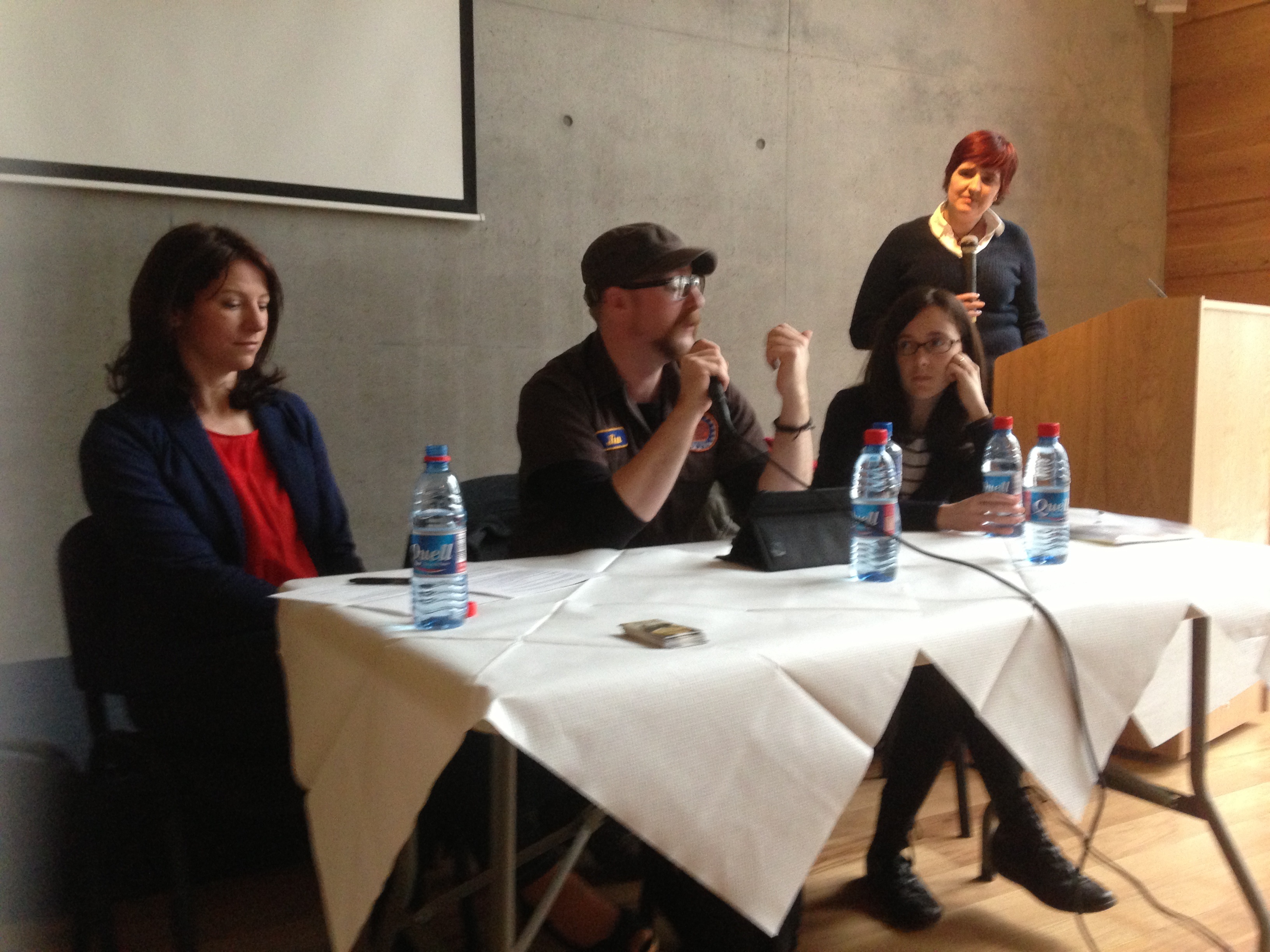
Event: To Blog or Not to Blog
Speakers (l-r): Hazel Gaynor, Mark Graham, Anna Carey, Mona Wise
Venue: Waterford Medieval Museum

Event: Writing Winning Short Stories
Speakers (l-r): Vanessa O’Loughlin (chair and festival curator), Declan Meade, Clem Cairns
Venue: Greyfriars Gallery

Event: “Love is the Easy Bit” by Mary Grehan book launch
Speakers (l-r): Caroline Senior, Managing Director of Garter Lane Arts Centre, author Mary Grehan
Venue: Garter Lane Arts Centre
The festival organisers really hit it out of the park this year. One of them told me that their aim with the programme was to focus on the writers. They certainly achieved this aim with a line-up of events that covered a huge range of the skills that today’s writers need, or at least need to be aware of: social media, self-publishing, blogging, how to approach writing competitions, breaking into journalism, and more.
The panel discussion format was used for most of the events I attended. This worked very well. With the best intentions in the world, the audience can start to get a bit glassy-eyed at events where a single person speaks for an hour or more. With panel discussions, on the other hand, there is a variety of faces and voices to sustain your attention, the discussion is naturally more varied and dynamic, and there is a chairperson to keep it all together, move things along when required, field audience questions, and make sure everyone gets their say.
A highlight for me was the final event of the weekend, which was held last night in Garter Lane Arts Centre. It was the launch of Mary Grehan‘s novel, Love is the Easy Bit. Mary is a huge success story: she is the only new author to be signed by Penguin Ireland in the last 18 months. We are very proud of her here in Waterford and delighted to bask in her reflected glory.
The format of the launch was interesting. We all took our seats in the theatre auditorium and Mary gave an excellent reading. She was then interviewed on stage, which was highly entertaining and interesting. Lastly, there were questions from the audience by means of a roving microphone.
The organisers of Waterford Writers’ Weekend have set the bar very high for themselves if they are to make next year’s festival as good as or better than this one. But they are a bunch of highly motivated, organised and ambitious folk. I’m looking forward to WWW14 already!
PS. Needless to say, there were lots of other events over the weekend that I didn’t make it to. If anyone out there wants to contribute something about any of those other events, I’d love to hear from you in the comments below.
Waterford Writers’ Weekend 2013 venue review #4: Café Royal
The event that I’m involved in for Waterford Writers’ Weekend 2013 is on the day after tomorrow. It’s a panel discussion on the topic of Making Social Media Work for You and it’s on Friday March 22nd, 1 -2 PM, Greyfriars, Waterford. One of my fellow panelists is Catherine Ryan Howard, Ireland’s most successful self-published author and a master of using social media for promotion. The event is relevant to anyone who uses social media in their work – small business owners, employees, and arts professionals of all hues. You can book your place here.
OK, shameless plug over. Time for the latest of my reviews of venues to visit in Waterford over the festival weekend.
Café Royal, Theatre Royal, The Mall, Waterford

Food and drink: A fairly standard menu of sandwiches, panini, salads, breakfasts and desserts. The quality of the food is good, most items are home made and there are gluten-free and dairy-free options. Salads are imaginative and change daily. The coffee is very good. The breakfasts are ideal if you’re in town first thing in the morning – I like the two-egg omelette breakfast with two rashers, two sausages and two slices of toast. There are child-friendly options in the form of cartons of juice (as all parents know, the least messy child’s drink when you are out) and cookies, though the cookies are over-priced, as they are everywhere (they’re only big biscuits!).
Service: Table service. The staff are very friendly and helpful. On festival weekends, the cafe people set up a stall by the main door of the theatre (which is at the side, a little confusingly if you’re new to Waterford) selling sweet treats and coffee, to save you climbing the stairs.
Layout and accessibility: This cafe is all location, location, location, and in more ways than one.
Firstly, it’s on the first floor of the Theatre Royal, the former Georgian playhouse that today houses Waterford’s beautiful, best-known theatre and is one of the main venues for Waterford Writers’ Weekend. There’s a treat in store for art lovers on the way up the stairs: the walls are lined with a selection of pieces from the Waterford Municipal Art Collection. Among them is an all-time favourite of mine, the wonderful Curiosity by William Conor.
Secondly, grab a window seat if you can, because this cafe has the most historic view in Waterford city. Right across the street you will see the Irish tricolour fluttering in the breeze. The building from which the flag hangs marks the spot where the tricolour was first unveiled by Irish revolutionary Thomas Frances Meagher in March 1848. This event is now celebrated every year in Waterford by the 1848 Tricolour Festival.
Thirdly, stay in that window seat, especially if you have an interest in architecture, or just like looking at beautiful buildings. The cafe overlooks part of Waterford’s Viking Triangle, including the Bishop’s Palace, home to the Georgian collection of the Waterford Museum of Treasures – a fantastic place to visit, whether you’re local or a visitor – the House of Waterford Crystal with its eye-popping window displays and, if you crane your neck, the Waterford Medieval Museum, a recently added architectural delight. The Mall, an elegant, tree-lined Georgian street, also lies stretched out below.
As for accessibility, the cafe can be reached by lift. There is just about enough space between tables for a buggy or wheelchair. The tables are set back a little from the door so you have space to stop and look around when you go in.
Toilet facilities: The toilets are handily located just off the main cafe. Toilets are functional and clean though a little cramped. There is no changing table, a strange omission in a cafe that has high chairs; children who need high chairs are going to need changing too. On the plus side, there is a hook on the back of the toilet door. (This may seem like a trivial point, but us lay-dees really don’t like having to leave our bags on the toilet floor …)
Free wi-fi: Yes.
Parking: There are a few on-street parking spaces on The Mall, directly outside the theatre, but they are almost always full. Instead, head to Catherine Street, a two-minute walk, or Waterside, a four-minute walk, where on-street parking is more plentiful. Alternatively, park in the Bolton Street car park, a two-minute walk. This car park has no daily limit, so you can leave your car there as long as you like. Charges: €1.80 per hour.
As I mentioned in my last review, if you’re planning to head to several festival events over the day, park in the private car park just off Thomas Hill (head up the hill, follow the street around to the right, entrance is on the right) for €5.00 a day flat rate.
Accessibility to festival venues: The Theatre Royal is one of the main venues at Waterford Writers’ Weekend. Other festival venues are a maximum of five minutes’ walk away.
Waterford Writers’ Weekend 2013 venue review #3: The Granary café
Tempus is fugiting! Saint Patrick’s Day is now behind us and Waterford Writers’ Weekend 2013 is right in front of us. So here’s the third in my series of reviews of alternative venues to visit over the festival weekend.
The Granary café, Hanover Street, Waterford

Food and drink: Above average prices with standards to match. On offer are quiches, pies, salads, panini and daily specials. Everything is of exceptional quality. The salads in particular are among the best I have had anywhere; the beetroot and carrot salad takes the two humble roots to new heights. The main dishes change daily; a recent example is pan-fried hake with lemon and tarragon cream. The coffee is very good, though not the best in Waterford (for that, see my previous venue review). If you are booked in to any of the early morning events at Waterford Writers’ Weekend, the mushroom omelette breakfast (two-egg omelette with mushrooms, sausage, rasher and wholemeal toast) comes highly recommended.
Service: Self-service. The counter staff are highly efficient, though some are not given to smiling. An exception is manager Artur, who is equally efficient and very friendly.
Layout and accessibility: The cafe is located in a high-ceilinged, glass-walled extension to the beautiful old granary building. These days, the former granary is home to the Waterford Institute of Technology School of Architecture.
The cafe itself, located on the ground floor, is one of the best in Waterford in terms of accessibility and family-friendliness. The main doors have no steps or door-sills. Inside, there is plenty of space to manoeuvre wheelchairs and buggies. The seating area is large, and there are leather sofas and good-sized coffee tables at the back by the lift. This area is also good for quiet conversation, and local movers and shakers of the arts and commerce are often to be seen holding meetings here.
Toilet facilities: Upstairs, accessible by lift only. The lift itself is well located. The toilets have baby changing facilities.
Free wi-fi: Yes.
Parking: There is no parking directly outside as Hanover Street is pedestrianised. The nearest on-street parking is on Thomas Hill, across O’Connell Street. A little farther away, there is the car park on Little Patrick Street behind The Book Centre. Charges: €1.80 per hour.
If you’re planning to head to several events over the day, park in the private car park just off Thomas Hill (head up the hill, follow the street around to the right, entrance is on the right) for €5.00 a day flat rate.
Accessibility to festival venues: The Granary is a 60-second walk from Garter Lane theatre, one of the main venues at Waterford Writers’ Weekend. Other festival venues are a maximum of five minutes’ walk away.
Waterford Writers’ Weekend 2013 venue review #2: Café Libro
In my last post I introduced my series of reviews of alternative venues to visit during Waterford Writers’ Weekend 2013. Here’s review number two!
Café Libro, The Book Centre, 25 John Roberts Square

Food and drink: the menu looks ordinary enough at first glance – pre-packed sandwiches, pizza, cakes and pastries, coffee – but the quality and freshness of the ingredients elevate the fare here well above the ordinary. The made-to-order pizzas have fabulously thin bases and the sandwiches are delicious. The cakes and pastries are home-made by local artisan bakers, which is particularly commendable for a chain. The cinnamon rolls are worth the visit alone. And the coffee is – drum roll – the best in the city.
Service: Very good. Friendly and efficient. Order at the counter and staff bring your goodies to your table.
Layout and accessibility: Now we come to the real USP of Cafe Libro. Like the other cafes in the chain, it is situated in a book store. But this one is special, because it is in The Book Centre. This book store is notable on two fronts: it is one of Ireland’s few remaining independent book stores; and it is housed in a former cinema. The cafe is located on the mezzanine, overlooking the ground floor and main entrance – ideal for people-watching. The atrium construction preserves the cinema feel.
Appropriately, the cafe serves as an informal meeting place for writers, and many can be spotted here on weekdays mornings, tapping feverishly on their MacBooks. The tables are quite close together, but not unreasonably so. There are leather sofas and a low coffee table near the counter. The walls are lined with books on sale just like the rest of the store, and the ceiling is decorated with an impressive newspaper collage made from real newspapers (I checked with the manager!).
Accessibility is fine for the non-mobility-impaired, but if you use a wheelchair, or have a buggy or pram, this is where things get tricky (despite the sign outside proclaiming the cafe to be “child-friendly”). There is a lift in the building, but it only goes to the higher floor, not the mezzanine. Buggy users have two options: fold up your buggy and carry it up the stairs (hopefully you will have someone with you to carry the child), or leave the buggy downstairs. Wheelchair users have no means of access that I have been able to make out.
Toilet facilities: up a flight of stairs, basic, clean, very cramped, no baby changing facilities.
Free wi-fi: yes.
Parking: behind The Book Centre on Little Patrick Street. Charges: up to €1.80 per hour.
Accessibility to festival venues: this cafe is bang in the city centre, within two or three minutes’ walking distance of all festival venues.

 Orla Shanaghy's blog - Wait til I tell you