Category Archives: Writing
Good Friday, a 400-year-old poet, and a bit of heavy metal
I was reminded today of a poem I had not read in years (thank you, Twitter): Goodfriday, 1613. Riding Westward by John Donne. Today, Good Friday, is the 400th anniversary of the poem’s composition.
Now it’s not too often that 400-year-old poets crop up on Twitter, let alone one who has been a favourite of mine since secondary school, so to celebrate both that and the anniversary, I hunted out a gift from a long-time friend:

Beautiful, isn’t it? It’s No Man is an Island, a selection of Donne’s prose printed by The Folio Society of London. As the picture shows, it comes in its own lovely box, and the cover features those lines of Donne that have become part of the English language (and, curiously, Metallica songs):

Bizarrely (to me at any rate), when my friend gave me the book, and I thanked her for remembering that Donne was a favourite of mine, she replied, “I didn’t know that – I just thought it’d be your kind of thing”. Ever since then I have fantasised that Donne and I have some kind of connection across the centuries. (You have to be a bit deluded to be a writer.)
As favourite artists tend to do, Donne seems to have been there at other key stages throughout my life, too. I first discovered him thanks to the Leaving Certificate English syllabus in school. All the talk of “metaphysical poets” (a much-disputed label, incidentally) and “conceits” could have put anyone off Donne for life. Thankfully, the work shone through and made a lasting impression.
Later, it seemed to our teenage selves an epic meeting of minds when my boyfriend and I discovered a shared love of Donne’s The Good-Morrow:
“If ever any beauty I did see, Which I desired, and got, ’twas but a dream of thee.”(You may be feeling faintly queasy now, but this is powerful stuff when you’re 17.)
In terms of popularity, Donne’s work seems to have come full circle. King James I was just one of Donne’s contemporaries who admired the writer’s work, describing his sermons as like “ye peace of God, they passed all understanding”. After falling out of favour for a while, Donne experienced a resurgence in the twentieth century, and has become an established presence in English Literature syllabi the world over.
John Donne was a highly capable, ambitious man who understood how to create and manage his own reputation. I wonder what he would have thought if he had known that 400 years later, people who had never heard of him (and angry, long-haired heavy metal types) would still be quoting his lines.

John Donne, 1572 – 1631
Waterford Writers’ Weekend 2013 – a look back

Phew! Another Waterford Writers’ Weekend has been and gone.
I was delighted to make it to five events over the weekend. Here’s an overview in pictures.

Event: Making Social Media Work for You
Speakers (l-r): Orla Shanaghy, Catherine Ryan-Howard, Derbhile Graham (chair), Derek Flynn
Venue: Greyfriars Gallery

Event: Self-Publishing
Speakers (l-r): Hazel Gaynor, Catherine Ryan-Howard (chair), Sheena Lambert
Venue: Sabai restaurant
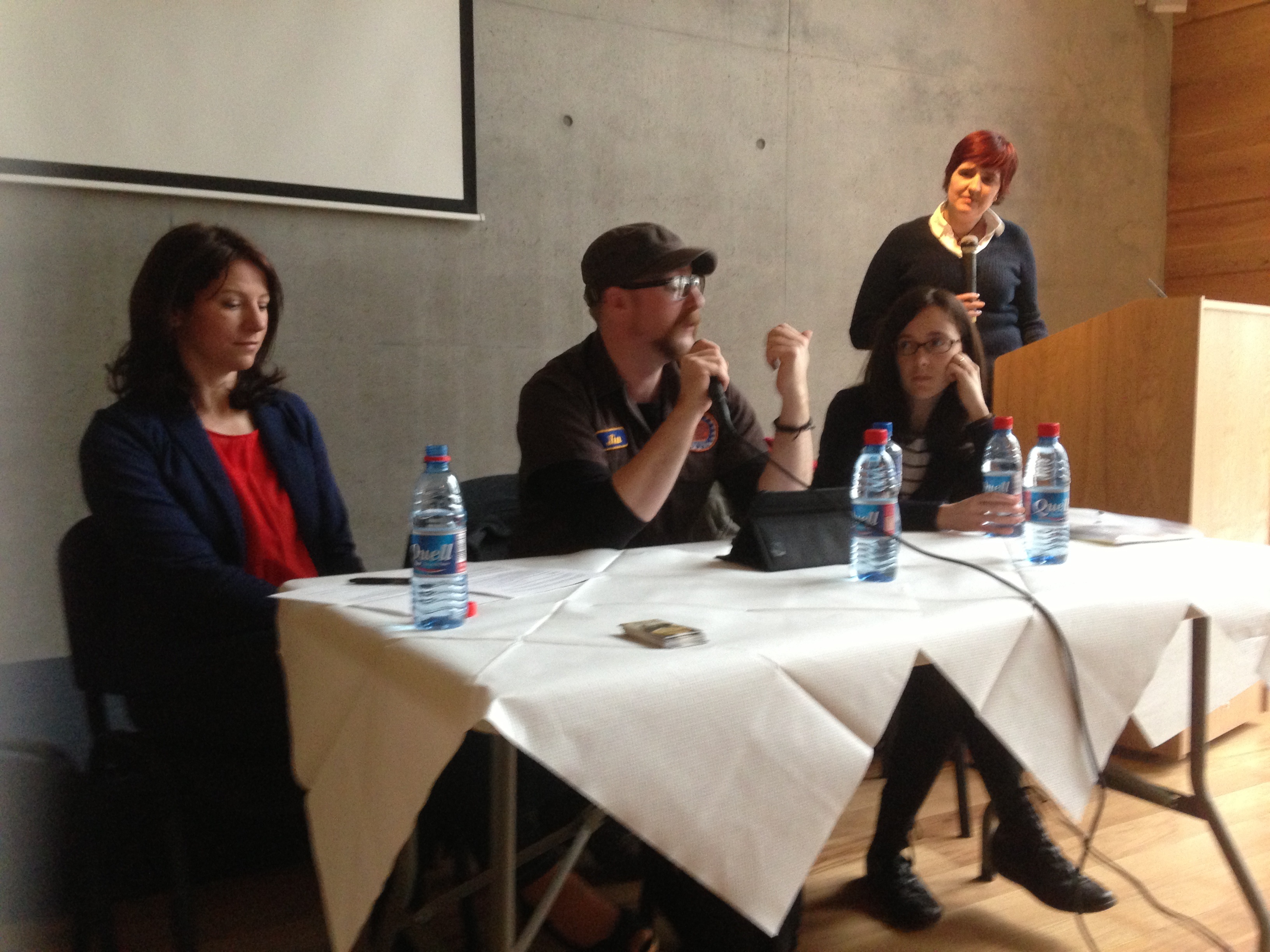
Event: To Blog or Not to Blog
Speakers (l-r): Hazel Gaynor, Mark Graham, Anna Carey, Mona Wise
Venue: Waterford Medieval Museum

Event: Writing Winning Short Stories
Speakers (l-r): Vanessa O’Loughlin (chair and festival curator), Declan Meade, Clem Cairns
Venue: Greyfriars Gallery

Event: “Love is the Easy Bit” by Mary Grehan book launch
Speakers (l-r): Caroline Senior, Managing Director of Garter Lane Arts Centre, author Mary Grehan
Venue: Garter Lane Arts Centre
The festival organisers really hit it out of the park this year. One of them told me that their aim with the programme was to focus on the writers. They certainly achieved this aim with a line-up of events that covered a huge range of the skills that today’s writers need, or at least need to be aware of: social media, self-publishing, blogging, how to approach writing competitions, breaking into journalism, and more.
The panel discussion format was used for most of the events I attended. This worked very well. With the best intentions in the world, the audience can start to get a bit glassy-eyed at events where a single person speaks for an hour or more. With panel discussions, on the other hand, there is a variety of faces and voices to sustain your attention, the discussion is naturally more varied and dynamic, and there is a chairperson to keep it all together, move things along when required, field audience questions, and make sure everyone gets their say.
A highlight for me was the final event of the weekend, which was held last night in Garter Lane Arts Centre. It was the launch of Mary Grehan‘s novel, Love is the Easy Bit. Mary is a huge success story: she is the only new author to be signed by Penguin Ireland in the last 18 months. We are very proud of her here in Waterford and delighted to bask in her reflected glory.
The format of the launch was interesting. We all took our seats in the theatre auditorium and Mary gave an excellent reading. She was then interviewed on stage, which was highly entertaining and interesting. Lastly, there were questions from the audience by means of a roving microphone.
The organisers of Waterford Writers’ Weekend have set the bar very high for themselves if they are to make next year’s festival as good as or better than this one. But they are a bunch of highly motivated, organised and ambitious folk. I’m looking forward to WWW14 already!
PS. Needless to say, there were lots of other events over the weekend that I didn’t make it to. If anyone out there wants to contribute something about any of those other events, I’d love to hear from you in the comments below.
Waterford Writers’ Weekend 2013 venue review #4: Café Royal
The event that I’m involved in for Waterford Writers’ Weekend 2013 is on the day after tomorrow. It’s a panel discussion on the topic of Making Social Media Work for You and it’s on Friday March 22nd, 1 -2 PM, Greyfriars, Waterford. One of my fellow panelists is Catherine Ryan Howard, Ireland’s most successful self-published author and a master of using social media for promotion. The event is relevant to anyone who uses social media in their work – small business owners, employees, and arts professionals of all hues. You can book your place here.
OK, shameless plug over. Time for the latest of my reviews of venues to visit in Waterford over the festival weekend.
Café Royal, Theatre Royal, The Mall, Waterford

Food and drink: A fairly standard menu of sandwiches, panini, salads, breakfasts and desserts. The quality of the food is good, most items are home made and there are gluten-free and dairy-free options. Salads are imaginative and change daily. The coffee is very good. The breakfasts are ideal if you’re in town first thing in the morning – I like the two-egg omelette breakfast with two rashers, two sausages and two slices of toast. There are child-friendly options in the form of cartons of juice (as all parents know, the least messy child’s drink when you are out) and cookies, though the cookies are over-priced, as they are everywhere (they’re only big biscuits!).
Service: Table service. The staff are very friendly and helpful. On festival weekends, the cafe people set up a stall by the main door of the theatre (which is at the side, a little confusingly if you’re new to Waterford) selling sweet treats and coffee, to save you climbing the stairs.
Layout and accessibility: This cafe is all location, location, location, and in more ways than one.
Firstly, it’s on the first floor of the Theatre Royal, the former Georgian playhouse that today houses Waterford’s beautiful, best-known theatre and is one of the main venues for Waterford Writers’ Weekend. There’s a treat in store for art lovers on the way up the stairs: the walls are lined with a selection of pieces from the Waterford Municipal Art Collection. Among them is an all-time favourite of mine, the wonderful Curiosity by William Conor.
Secondly, grab a window seat if you can, because this cafe has the most historic view in Waterford city. Right across the street you will see the Irish tricolour fluttering in the breeze. The building from which the flag hangs marks the spot where the tricolour was first unveiled by Irish revolutionary Thomas Frances Meagher in March 1848. This event is now celebrated every year in Waterford by the 1848 Tricolour Festival.
Thirdly, stay in that window seat, especially if you have an interest in architecture, or just like looking at beautiful buildings. The cafe overlooks part of Waterford’s Viking Triangle, including the Bishop’s Palace, home to the Georgian collection of the Waterford Museum of Treasures – a fantastic place to visit, whether you’re local or a visitor – the House of Waterford Crystal with its eye-popping window displays and, if you crane your neck, the Waterford Medieval Museum, a recently added architectural delight. The Mall, an elegant, tree-lined Georgian street, also lies stretched out below.
As for accessibility, the cafe can be reached by lift. There is just about enough space between tables for a buggy or wheelchair. The tables are set back a little from the door so you have space to stop and look around when you go in.
Toilet facilities: The toilets are handily located just off the main cafe. Toilets are functional and clean though a little cramped. There is no changing table, a strange omission in a cafe that has high chairs; children who need high chairs are going to need changing too. On the plus side, there is a hook on the back of the toilet door. (This may seem like a trivial point, but us lay-dees really don’t like having to leave our bags on the toilet floor …)
Free wi-fi: Yes.
Parking: There are a few on-street parking spaces on The Mall, directly outside the theatre, but they are almost always full. Instead, head to Catherine Street, a two-minute walk, or Waterside, a four-minute walk, where on-street parking is more plentiful. Alternatively, park in the Bolton Street car park, a two-minute walk. This car park has no daily limit, so you can leave your car there as long as you like. Charges: €1.80 per hour.
As I mentioned in my last review, if you’re planning to head to several festival events over the day, park in the private car park just off Thomas Hill (head up the hill, follow the street around to the right, entrance is on the right) for €5.00 a day flat rate.
Accessibility to festival venues: The Theatre Royal is one of the main venues at Waterford Writers’ Weekend. Other festival venues are a maximum of five minutes’ walk away.
Waterford Writers’ Weekend 2013 venue review #3: The Granary café
Tempus is fugiting! Saint Patrick’s Day is now behind us and Waterford Writers’ Weekend 2013 is right in front of us. So here’s the third in my series of reviews of alternative venues to visit over the festival weekend.
The Granary café, Hanover Street, Waterford

Food and drink: Above average prices with standards to match. On offer are quiches, pies, salads, panini and daily specials. Everything is of exceptional quality. The salads in particular are among the best I have had anywhere; the beetroot and carrot salad takes the two humble roots to new heights. The main dishes change daily; a recent example is pan-fried hake with lemon and tarragon cream. The coffee is very good, though not the best in Waterford (for that, see my previous venue review). If you are booked in to any of the early morning events at Waterford Writers’ Weekend, the mushroom omelette breakfast (two-egg omelette with mushrooms, sausage, rasher and wholemeal toast) comes highly recommended.
Service: Self-service. The counter staff are highly efficient, though some are not given to smiling. An exception is manager Artur, who is equally efficient and very friendly.
Layout and accessibility: The cafe is located in a high-ceilinged, glass-walled extension to the beautiful old granary building. These days, the former granary is home to the Waterford Institute of Technology School of Architecture.
The cafe itself, located on the ground floor, is one of the best in Waterford in terms of accessibility and family-friendliness. The main doors have no steps or door-sills. Inside, there is plenty of space to manoeuvre wheelchairs and buggies. The seating area is large, and there are leather sofas and good-sized coffee tables at the back by the lift. This area is also good for quiet conversation, and local movers and shakers of the arts and commerce are often to be seen holding meetings here.
Toilet facilities: Upstairs, accessible by lift only. The lift itself is well located. The toilets have baby changing facilities.
Free wi-fi: Yes.
Parking: There is no parking directly outside as Hanover Street is pedestrianised. The nearest on-street parking is on Thomas Hill, across O’Connell Street. A little farther away, there is the car park on Little Patrick Street behind The Book Centre. Charges: €1.80 per hour.
If you’re planning to head to several events over the day, park in the private car park just off Thomas Hill (head up the hill, follow the street around to the right, entrance is on the right) for €5.00 a day flat rate.
Accessibility to festival venues: The Granary is a 60-second walk from Garter Lane theatre, one of the main venues at Waterford Writers’ Weekend. Other festival venues are a maximum of five minutes’ walk away.
Waterford Writers’ Weekend 2013 venue review #2: Café Libro
In my last post I introduced my series of reviews of alternative venues to visit during Waterford Writers’ Weekend 2013. Here’s review number two!
Café Libro, The Book Centre, 25 John Roberts Square

Food and drink: the menu looks ordinary enough at first glance – pre-packed sandwiches, pizza, cakes and pastries, coffee – but the quality and freshness of the ingredients elevate the fare here well above the ordinary. The made-to-order pizzas have fabulously thin bases and the sandwiches are delicious. The cakes and pastries are home-made by local artisan bakers, which is particularly commendable for a chain. The cinnamon rolls are worth the visit alone. And the coffee is – drum roll – the best in the city.
Service: Very good. Friendly and efficient. Order at the counter and staff bring your goodies to your table.
Layout and accessibility: Now we come to the real USP of Cafe Libro. Like the other cafes in the chain, it is situated in a book store. But this one is special, because it is in The Book Centre. This book store is notable on two fronts: it is one of Ireland’s few remaining independent book stores; and it is housed in a former cinema. The cafe is located on the mezzanine, overlooking the ground floor and main entrance – ideal for people-watching. The atrium construction preserves the cinema feel.
Appropriately, the cafe serves as an informal meeting place for writers, and many can be spotted here on weekdays mornings, tapping feverishly on their MacBooks. The tables are quite close together, but not unreasonably so. There are leather sofas and a low coffee table near the counter. The walls are lined with books on sale just like the rest of the store, and the ceiling is decorated with an impressive newspaper collage made from real newspapers (I checked with the manager!).
Accessibility is fine for the non-mobility-impaired, but if you use a wheelchair, or have a buggy or pram, this is where things get tricky (despite the sign outside proclaiming the cafe to be “child-friendly”). There is a lift in the building, but it only goes to the higher floor, not the mezzanine. Buggy users have two options: fold up your buggy and carry it up the stairs (hopefully you will have someone with you to carry the child), or leave the buggy downstairs. Wheelchair users have no means of access that I have been able to make out.
Toilet facilities: up a flight of stairs, basic, clean, very cramped, no baby changing facilities.
Free wi-fi: yes.
Parking: behind The Book Centre on Little Patrick Street. Charges: up to €1.80 per hour.
Accessibility to festival venues: this cafe is bang in the city centre, within two or three minutes’ walking distance of all festival venues.
Waterford Writers’ Weekend 2013 venue review #1: Harlequin cafe-bar

Waterford Writers’ Weekend 2013 is fast approaching. This is one of the smaller of Waterford’s many festivals throughout the year, but that doesn’t stop it from being a vital, vibrant weekend.
One of the challenges faced by festival organisers the world over is to vary the content of their festival programmes from year to year. The Waterford Writers’ Weekend organisers, Waterford City Library, Galanta Events and Vanessa O’ Loughlin of writing.ie, certainly seem to have achieved that this year. The focus of the programme is on emerging writers, self-publishing, independent publishing and social media.
The Weekend has a selection of official venues and partners, all of which are great and worth visiting. I thought it might be useful in the run-up to the festival to attempt to complement the official list by posting reviews and information on additional venues from the viewpoint of a local person.
These venues are perhaps lesser known for whatever reason, but offer people something different and a good reason to venture off Waterford’s main thoroughfares and do some exploring.
I’ll make my reviews as practical as possible by including information on parking, toilet facilities, accessibility, child-friendliness, availability of wi-fi and any other useful tips.
Here’s my first venue review!
Harlequin cafe-bar, Stephen Street
Food and drink: Authentic home-made Italian food – such as gnocchi with gorgonzola sauce – great coffee, good selection of Italian wine. The staff don’t mind you popping in for just a coffee and pastry or a glass of wine.
Service: Excellent. Beautiful native Italian coming from the staff as they work. Some of the best-looking male staff in the city (sorry, men of Waterford!).
Layout and accessibility: compact, tables close together. Buggies have to be folded up and even at that there is not much space to stow them. Having said that, the staff are very welcoming of families with small children. Wheelchair users should be able to get in the door easily as there is no step.
Toilet facilities: on same level, basic, clean, slightly cramped, no baby changing facilities.
Free wi-fi: yes.
Parking: on-street outside the cafe or nearby Mayor’s Walk. Charges: up to €1.80 per hour.
Accessibility to festival venues: maximum 10-minute walk (if you’re a slow walker – five minutes power-walking!).
Don’t work hard, work soft
I love the term “soft eyes”. I first came across it in The Wire (“Refugees”, Episode 4, Season 4) and it has stayed with me since.
Det. Kima Greggs and her soft eyes, as seen in “The Wire”. Image: tumblr.com.
In that episode, new arrival to the Homicide department Detective Kima Greggs is sent to her first crime scene. An experienced colleague advises her to use “soft eyes” – that is, to take a wide overview of the scene and let intuition and the subconscious come into play in order to spot things and make connections.
Getting bogged down or stuck in details is a problem shared not just by writers, or even creative types in general, but by anyone with a creative aspect to their work.
I am currently in the early stages of writing one of the stories in my work-in-progress short story collection. I had been floundering around for a few days, trying to work out the finer details of certain scenes.
Then I remembered about soft eyes. I zoomed out in my mind’s eye, brought the scenes into soft focus, and let my mind do its thing for a while.
Mentally, this process (or some variant of it) is what happens when you put on your soft eyes. Physically, you can help soft eyes happen if you sit back, close or half-close your eyes, do some slow breathing or shoulder rolls – anything that you find relaxing.
Linda Formichelli discussed a similar idea the other day on her blog The Renegade Writer. In a post titled “Are you pushing away ideas – and work – by trying too hard?”, Linda’s main points are:
- Focus on the input, not the output: it’s easy to get caught up in producing output, but you need to feed your creativity by absorbing other material.
- Go wide, not deep: this is the idea I mentioned above of not drilling narrowly into details at the expense of the bigger picture. As Linda says, this is intended to be an easy, relaxed process: “Just take [ideas] in and let your subconscious do the work.”
- Be playful: anyone who is familiar with the techniques of Mindfulness will know this as a creativity-enhancing technique called “habit releasers”. Brush your teeth with the other hand, or go to the cinema and see a movie at random rather than planning and booking ahead. The idea is to get your mind “unstuck”.
These techniques also tie in with some good advice I have heard from Nuala Ní Chonchúir in her short story workshops: don’t get tied up too much with plot. Instead, just get writing, and plot will emerge. This to me is a related idea, as it too focuses on relaxing and trusting the subconscious.
Try it! And after you do, post a comment below. I’d love to hear how “soft eyes” works for you.
Guest post: Love letter to Germany (and Currywurst)
Today I’m delighted to feature a guest post by Kalle Ryan, Waterford / Dublin performance poet, humourist, MC of The Brownbread Mixtape monthly cabaret in Dublin, and possessor of a host of other talents.
This article originally appeared in The Metro Herald, 17/11/2012.
![Zeppelubil / Th. Haft / Torgau [CC-BY-SA-3.0 (http://creativecommons.org/licenses/by-sa/3.0)], via Wikimedia Commons](https://waittilitellyou.com/wp-content/uploads/2012/11/schlossneuschwanstein20111.jpg "Schloss Neuschwanstein")
Schloss Neuschwanstein in Southern Bavaria, inspiration for the “Disney” castle (and more importantly, nice to gaze up at while you scoff Schnitzel).
These days when you think of Germany, you inevitably picture Angela Merkel’s Sauerkraut face and her corresponding punitive, penny-pinching proclamations. If you’re more of an old school German thinker, you may have thoughts of wicked World Wars and a land fabled for being humourless, yet funnily drawn to David Hasselhoff’s musical skills.
But those broad strokes are ultimately unfair to a country, that I believe, is home to some of the great unsung secrets and joys of Europe.
As a teenager I travelled the length of Germany in a camper van with my family. It was a remarkable holiday that left a deep impression that lingers to this day. What I encountered was a country of wonderful variety, breathtaking beauty, fantastic food and incredibly warm people (with mullets, a lot of mullets).
We entered the country from the northern city of Hamburg, with its eclectic mix of erotic shops and Liverpudlian musical history, and bombed down the Autobahn (poor choice of verb when talking about Germany, I know) towards the magical city of Berlin.
Berlin really felt like the New York of Europe to me, with its wonderful blend of fascinating German design, historical landmarks, reliable and punctual public services, delightful local beers, as well as cool, punk-influenced, left-leaning art on every other street corner. How could you not love a city that was run by punctual hippies?
![By Rainer Z ... (Own work) [GFDL (http://www.gnu.org/copyleft/fdl.html) or CC-BY-SA-3.0-2.5-2.0-1.0 (http://creativecommons.org/licenses/by-sa/3.0)], via Wikimedia Commons](https://waittilitellyou.com/wp-content/uploads/2012/11/currywurst-1.jpg "Currywurst")
Currywurst
Our next stop along the way was Frankfurt, where I had a semi-religious experience as I encountered Germany’s legendary “Currywurst”. A char-grilled, flavourful sausage, sliced into discs and covered in a blanket of curried ketchup, then lightly dusted with fragrant yellow curry-powder. You simply have not lived until you have eaten this triumphant, teutonic takeaway treat. It is said that the secret to Germany’s continued automobile engineering success is founded upon a steady, streamlined diet of these curried sausages.
Sweeping south we entered the city of Stuttgart, home to the legendary Irish footballing victory over England in Euro 88. As an Irishman, the Neckarstadion ranks up there as a historical landmark alongside the GPO and The Hill of Tara. Stuttgart – a compact, cool city – is also home to the culinary delight of Maultaschen (German ravioli invented by monks to conceal meat from the Lord on Fridays). I recall thinking at the time that, if there were a World Cup for food, Germany would probably win that 1-0 every time too.
After several days of driving through swathes of the brilliant black forest, home to the legendary, delicious, unpronounceable Schwarzwälder Kirschtorte, we arrived in Munich. Located in the southern province of Bavaria (County Cork’s spiritual German sister), Munich is a wonderland of ornate buildings, sunlit plazas, moustachioed manly types, ample bosomed matronly types and crafted glasses of crisp, bubbly Hofbräuhaus beer. Basically, it is what Heaven would undoubtedly look like if it were run by Germany.
![By Mikelo (edited by User:Sashandre, User:Kozuch, User:Ras67 and User:MLWatts) (File:Black Forest gateau.jpg) [CC-BY-SA-3.0 (http://creativecommons.org/licenses/by-sa/3.0)], via Wikimedia Commons](https://waittilitellyou.com/wp-content/uploads/2012/11/black_forest_gateau_no_background.png)
Schwarzwälder Kirschtorte (Black Forest Gateau): much easier to eat than pronounce.
A short jaunt down the road, bordering Austria, was the charming town of Füssen, our final stop. Nestled up in the Alps above the town is crazy King Ludwig’s Schloss Neuschwanstein, widely known as the inspiration for the Disney castle, or, if you’re a Britpop fan, the cover photo of Blur’s ‘Country House’ single. Regardless of the imitators and appreciators, it’s a stunning sight and worth a visit, if only to sit down and eat some traditional Schnitzels in its shadow. This delicious, deep fried, breaded veal dish was invented by some genius from nearby Vienna, who should clearly have won the Nobel Prize.
While this might all sound like a food and drink travelogue / memoir, what it really amounts to is a love letter to a much maligned country that has levels of complexity and beauty far beyond simplistic jokes about the war or our present predicament. I have been back many times since and Germany continues to reward and reveal.
We are, of course, in a recession, so if you can’t afford to travel to Germany any time soon, then I strongly recommend that you stick on a Werner Herzog movie, crack open a cold German beer, pick up some authentic sausages from your local German supermarket and have a Currywurst party at home. Who knows, it may even make you feel more kindly toward Frau Merkel.
(c) Kalle Ryan 2012
@brownbreadmix
Applying corporate wisdom to the freelance world: seminar on Independent Publishing

Oliver Stone’s 1987 movie “Wall Street” brought corporate investment banker jargon to the wider world.
Multinational corporations are often derided for their use of “corporate-speak”. But as a former employee of multinational corporations, I have come to appreciate the value of some aspects of corporate wisdom. Two examples I wanted to write about today are outcomes and deliverables.
I recently attended a seminar hosted by Big Smoke Writing Factory in Dublin. The seminar was about Independent Publishing and the facilitator was Vanessa O’Loughlin, founder of writing.ie and The Inkwell Group, and influencer of a host of other literary activities and projects around Ireland.
To my delight, both the outcomes and deliverables of the seminar were excellent, and I met some lovely new fellow writers to boot.
Getting back to the corporate-speak. Freelancers pay for all training and professional development out of our own funds, so we need to make sure that we get a return on our investment. The most useful definition of ROI for freelancing purposes is that used in the financial world: “The money that a person or company earns as a percentage of the total value of his/her/its assets that are invested.”
The corporate world also teaches us that ROI in professional development is best measured in terms of the following two factors, one “hard” and one “soft”:
- Outcomes (“soft”) – something changes for the better as a result of you attending the training course. For example, your knowledge of the subject matter increases, you feel equipped to take specific actions, or you have a new qualification. If nothing changes as a result of you attending the course, there were no positive outcomes, and your money and time have been wasted.
- Deliverables (“hard”) – the specific, concrete things that were promised in the course description and that you take home with you at the end of the day. For example, a pile of useful notes or handouts (“useful” is key here – we all know the horror of taking home stacks of handouts we will never look at again); new practical skills; or a piece of work that you were guided in producing during the course.
For me, the outcomes of the Independent Publishing seminar were:
- A solid grounding in the various aspects of independent publishing, both print and digital
- Knowledge of and confidence in implementing the practical steps in independently publishing my writing work
- Awareness of the increasing significance of independent publishing in the literary market
The deliverables were:
- A careful selection of useful handouts
- 15 pages of my own notes
- Individual advice from Vanessa
So, my ROI on the seminar has been very satisfactory so far.
Of course, it’s too soon yet to know whether the seminar helped with the ultimate outcome: getting published.
I have been considering for some time whether I should release some of my stories as standalone publications. Short stories lend themselves particularly well to the digital format, as evidenced by the success of Kindle Singles. As well as that, Amazon’s digital book sales exceeded their print sales in the US for the first time last year, so the market for digital definitely exists.
I’ll be posting regular updates on my adventures in independent and digital publishing. Watch this space.
PFO – please fight on
Rejection letters are a funny old thing.
When you start out as a writer, your rejections tend to be from smaller publications and lesser known websites.
After you have been diligently persisting for a few years, the rejections still come, but from loftier sources.
I recently received the following rejection letter from Ciaran Carty, editor of New Irish Writing, which appears monthly in the Irish Independent and has launched the careers of many prominent Irish writers, including Joseph O’ Connor, Dermot Bolger, Vona Groarke and Mary O’Malley.

The New Irish Writing page was started by David Marcus in The Irish Press in 1969 and is the longest-running creative writing feature of its kind in any Irish or British newspaper.
Ciaran Carty is also director of the Hennessy Awards. Work published in New Irish Writing is automatically entered into the prestigious Hennessy Awards.
So, after weeping onto my keyboard for a while, I’m now actually a bit chuffed that Ciaran Carty sent me a personally signed letter, even if it is their standard PFO. He even wrote my name by hand!
I will fight on.

 Orla Shanaghy's blog - Wait til I tell you